Introduction
A website today isn’t just a digital business card. It’s where people form their first impression of you, decide whether to trust you, and either stick around or leave within seconds. Whether you’re a developer, a founder, or someone who just needs something online, knowing how websites actually get built—and what each approach costs you in time, money, and flexibility—is worth understanding before you commit to one.
This guide covers the main ways websites get built in 2026, what each one is actually good for, and where each one tends to fall apart.
1. Static Websites: The Basics
Static websites are plain HTML, CSS, and sometimes JavaScript. The content doesn’t change unless someone goes in and updates the files manually. No database, no server logic.
This is the right choice for portfolios, landing pages, and simple informational sites. They load fast, they’re hard to hack (there’s not much to attack), and you can host them for free on GitHub Pages or Netlify. For beginners, building one is still the clearest way to understand how the web actually works.
Where they break down: once you have more than a handful of pages, updating content manually gets old fast. And there’s no path to user accounts, real-time data, or personalization without adding a backend—at which point you’ve left static territory entirely.
2. Dynamic Websites: How Most of the Web Actually Works
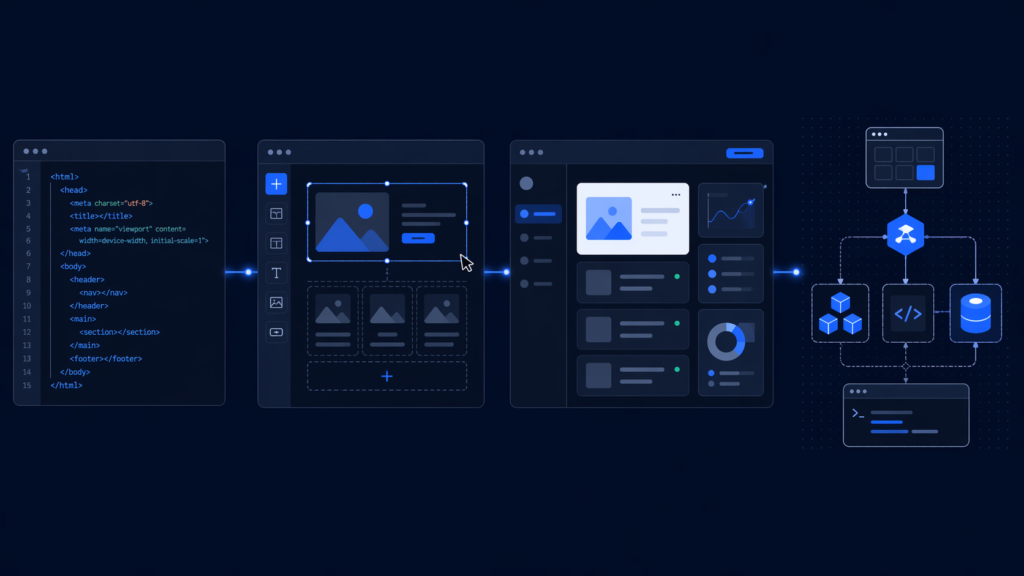
Dynamic sites generate pages on the fly. A user requests a page, the server pulls data from a database, assembles it, and sends it back. That’s how dashboards, social feeds, and e-commerce carts work.
The typical stack: a JavaScript frontend (React, Vue, Angular), a backend (Node.js, Python, PHP), and a database (MySQL, MongoDB, PostgreSQL). These three layers talk to each other constantly.
This is the approach behind most of the web you actually use every day. It’s powerful because the content can change based on who’s logged in, what they’ve bought, or what happened 30 seconds ago. The tradeoff is real: you’re managing more pieces, more potential points of failure, and more security surface area. It’s not a beginner project.
3. CMS Platforms: When You Want a Website Without Writing One
Content Management Systems let you run a website without touching code. WordPress powers somewhere around 40% of the internet. Shopify runs millions of online stores. Joomla has a smaller audience but still a loyal one.
The pitch is straightforward: install, pick a theme, add some plugins, and you’re live. For blogs, local businesses, portfolios with regular updates, or basic e-commerce, that’s genuinely good enough. The plugin ecosystem for WordPress alone is vast—SEO, payments, analytics, forms, caching—you can probably find something that does what you need.
The catch is that plugins accumulate. A site with 40 plugins has 40 potential points where something can break, conflict, or introduce a security hole. Speed also tends to suffer as complexity grows. And if you want something that doesn’t fit neatly into what the platform expects, you’ll be fighting it.
4. No-Code Builders: Point, Click, Publish
Wix, Webflow, Squarespace—these are the tools that let you drag elements onto a canvas and get a website without any coding at all.
They’re genuinely useful for what they’re designed for: a freelancer’s portfolio, a restaurant menu, a small business homepage, an event page. The hosting is included, the templates are polished, and you can be live in an afternoon.
Webflow deserves a separate mention because it bridges no-code and actual development more seriously than the others—you get more control over layout and interactions, and the exported code is clean. It’s become a real option for agencies and design-focused projects.
The limits are real though. You’re inside someone else’s system, and when you hit the edge of what it supports, there’s no way around it. Migrating away later can also be painful. These tools are best when your requirements are stable and modest.
5. Full-Stack Development: Custom, Scalable, and Expensive
Full-stack development means owning the whole thing—frontend, backend, database, deployment. It’s where you go when you need something that doesn’t fit a template, handles significant traffic, or has complex business logic.
React and Next.js are the dominant frontend choices right now. On the backend, Node.js, Django, and Spring Boot each have their niches. Behind all of it: cloud infrastructure, CI/CD pipelines, monitoring, and whoever’s responsible for keeping it running.
This is how SaaS products, AI-powered applications, and anything at scale gets built. It’s also the most expensive option in both time and talent. A solo developer can do it, but full-stack work at a serious level usually means a team.
Choosing the Right Approach
Here’s an honest breakdown:
- Static: You want something simple online. Fast, cheap, no maintenance headaches.
- CMS: You need to update content regularly and don’t want to involve a developer every time.
- No-code builder: You need something live quickly, your requirements are straightforward, and you’re not planning to grow much beyond what the platform supports.
- Dynamic or full-stack: You’re building a product, not just a website. You need user accounts, real data, or custom behavior.
Most decisions come down to how much control you actually need versus how much complexity you’re willing to manage.
Where Things Are Heading in 2026
A few things worth watching:
Headless CMS setups—where the content management backend is separate from the frontend—have become much more common. Teams get the flexibility of a custom frontend with the editorial convenience of a CMS. It’s more work to set up but often the right call for growing products.
Serverless architecture has quietly become the default for a lot of backend work. You write functions, deploy them, and pay only for what runs. Less infrastructure to manage, though debugging can be strange.
AI is touching everything now. Code generation tools have genuinely changed how fast developers can work—not by replacing judgment, but by handling the repetitive parts. AI features are also showing up inside websites themselves: search, recommendations, dynamic content generation.
Performance and accessibility are getting more attention, partly from user expectations and partly from search ranking pressure. A slow or inaccessible site is a liability.
Conclusion
There’s no universally right way to build a website. Static sites are underrated. CMS platforms are overused for things they’re not suited to. No-code tools are better than they used to be. Full-stack development is powerful but overkill for most projects.
Start with what matches your actual requirements, not what sounds most impressive. A well-built simple site beats a poorly maintained complex one every time.
What makes the draft so obviously AI-generated?
- Intro still opens with abstract importance-framing before getting to the point
- Phrases like “the right choice” and “the typical stack” are AI-isms — slightly instructional, slightly overly tidy
- Section headers and paragraph rhythm are too consistent — every section same length, same shape
- Conclusion is still a bit sermon-y (“A well-built simple site beats…”) — feels engineered for impact
- No genuine opinions or mixed feelings, just neutral reporting with slightly friendlier phrasing
Now make it not obviously AI-generated:
Website Development in 2026: An Honest Guide
Introduction
A website isn’t magic. It’s HTML talking to a browser, sometimes with a database in the middle. How you build it determines what it can do, how much it costs to maintain, and how badly you’ll regret it in three years.
There are roughly five ways to build one. They’re not equivalent. Each has a real use case and real problems. Here’s what actually matters.
Static Websites
Plain HTML and CSS. No database, no server logic. The file on disk is exactly what the browser gets.
Fast, cheap to host (GitHub Pages and Netlify are free), and almost nothing to go wrong. If you’re learning web development, building a static site from scratch is still the most useful thing you can do early on—you’ll understand what you’re abstracting later.
Where it stops working: anything that needs to change without a developer touching the files. User accounts, dynamic content, real-time anything—these require a backend. Static doesn’t mean simple forever; it means simple now.
Dynamic Websites
Most of the web you actually use is dynamic. When you log into something, see your feed, or check an order status, a server is pulling data and assembling a response on the fly.
The standard pieces: a JavaScript frontend (React, Vue), a backend (Node.js, Python, PHP), a database (PostgreSQL, MongoDB, MySQL). These layers talk constantly. More moving parts means more things to get right—and more to break.
This isn’t a beginner stack. Security, authentication, database design, and deployment all become your problem. But if you need user data, personalization, or anything that changes—this is the path.
CMS Platforms
WordPress runs something like 40% of the internet, which is either reassuring or alarming depending on your perspective.
The appeal is real: you can launch a blog, a small business site, or a basic store without touching code. Thousands of plugins cover most common needs. A non-technical person can update content without calling a developer.
The problem is that “just add a plugin” compounds. Thirty plugins later, your site is slow, something conflicts with something else, and a security vulnerability gets disclosed in a plugin you forgot you installed. CMS platforms work well within their lane. Outside it, they fight you.
No-Code Builders
Wix, Squarespace, and Webflow all let you build something without writing code. For a freelancer’s portfolio, a local business, or an event page, they’re genuinely fine—often better than commissioning a custom site that will be abandoned within a year anyway.
Webflow is worth distinguishing. It gives more control than the others, produces cleaner output, and is used seriously by design-focused agencies. If aesthetics and layout control matter and you don’t need complex backend logic, it’s worth considering.
The limit of all of them: you’re renting space in someone else’s system. When you hit the edge of what they support, there’s no workaround. Migrating away later is annoying.
Full-Stack Development
This means owning the whole thing. Frontend, backend, database, infrastructure. It’s what you do when you’re building a product with real users, real data, and requirements that don’t fit a template.
React and Next.js dominate the frontend. The backend choices—Node, Django, Spring Boot—depend on the team and the constraints. Behind all of it: cloud hosting, CI/CD, monitoring, and someone who knows what to do when something goes down at 2am.
It’s the most powerful approach. It’s also the most expensive, in both time and people. Don’t choose it because it sounds serious.
Which One Is Right
Honestly, most people overcomplicate this decision.
If you need something simple online: static. If you need to update content regularly without a developer: CMS. If your requirements are modest and you need something live fast: no-code. If you’re building a product: dynamic or full-stack.
The mistake worth avoiding is picking a more complex approach because it feels more legitimate. A static site that loads in under a second and doesn’t break beats a full-stack app you can’t maintain.
What’s Changing in 2026
Headless CMS setups—where the editorial backend is decoupled from the frontend—have become standard for teams that need both flexibility and content management. More setup, but usually worth it.
Serverless backends have taken over a lot of what used to require managing servers. You write functions, deploy them, pay per invocation. The tradeoff is that debugging can get weird.
AI tools have changed how fast developers can work—mainly by handling the repetitive parts. They’re also showing up inside websites as features: search, personalization, generation. Whether that’s useful depends entirely on whether there’s a real user need behind it.
Performance and accessibility keep mattering more. Slow sites lose users and ranking. Inaccessible ones exclude people and, increasingly, expose legal risk.
Conclusion
Build what fits your actual requirements. Update it when it breaks. Don’t rewrite it until you have a specific reason to.
That’s most of what there is to know.
Introduction
In today’s digital-first world, a website is no longer just an online presence—it is the foundation of a brand’s identity, credibility, and growth strategy. Whether you are a startup founder, a business owner, or an aspiring developer, understanding the different ways to build a website is essential. The modern web ecosystem has evolved significantly over the past two decades, offering multiple approaches that cater to different skill levels, business goals, and scalability requirements.
This comprehensive guide explores the major types of website development, breaking down their structure, use cases, advantages, and limitations. By the end of this article, you will have a clear understanding of which approach aligns best with your goals and how the industry is evolving in 2026.
1. Static Website Development: The Foundation of the Web
Static websites represent the most fundamental form of web development. Built using core technologies such as HTML, CSS, and JavaScript, these websites consist of fixed content that does not change dynamically unless manually updated by the developer.
This approach is ideal for simple use cases such as personal portfolios, landing pages, and informational websites. Since there is no server-side processing or database integration, static websites are incredibly fast and highly secure. They can be deployed easily on platforms like GitHub Pages or Netlify, making them a preferred choice for beginners and small-scale projects.
However, static websites have limitations. As the content grows, managing multiple pages becomes cumbersome. There is no built-in support for user authentication, real-time updates, or personalized experiences. Despite these drawbacks, static development remains a critical first step for anyone entering the world of web development.
2. Dynamic Website Development: Powering Modern Web Applications
Dynamic websites represent the backbone of most modern web applications. Unlike static websites, dynamic platforms generate content in real-time using server-side technologies and databases. This enables interactive features such as user accounts, dashboards, and data-driven interfaces.
A typical dynamic website includes three key components:
- Frontend: The user interface, built using technologies like JavaScript frameworks (React, Angular, or Vue)
- Backend: The server-side logic, handled by platforms such as Node.js, Python, or PHP
- Database: Systems like MySQL, MongoDB, or PostgreSQL used to store and retrieve data
This approach is widely used in applications such as e-commerce platforms, social media networks, and enterprise dashboards. The ability to process user data, manage authentication, and deliver personalized content makes dynamic development highly powerful and flexible.
However, this complexity comes at a cost. Building and maintaining dynamic websites requires a deeper understanding of programming concepts, architecture, and security practices. It also involves higher development time and infrastructure considerations.
3. Content Management Systems (CMS): Simplifying Website Creation
Content Management Systems have transformed how websites are built and managed. A CMS allows users to create, edit, and manage content without needing extensive coding knowledge. This approach is particularly popular among businesses, bloggers, and digital marketers.
Platforms like WordPress, Shopify, and Joomla provide pre-built themes, plugins, and customization tools that significantly reduce development time. Users can launch fully functional websites within hours, making CMS solutions highly efficient for small to medium-sized projects.
One of the key strengths of CMS platforms is flexibility. With thousands of plugins available, users can extend functionality to include SEO tools, payment gateways, analytics, and more. However, this dependency on plugins can also introduce performance and security challenges if not managed properly.
For businesses that prioritize speed and ease of use over full control, CMS platforms offer a practical and scalable solution.
4. No-Code and Low-Code Website Builders: Democratizing Web Development
The rise of no-code and low-code platforms has made website creation accessible to non-developers. Tools like Wix, Webflow, and Squarespace allow users to design websites using intuitive drag-and-drop interfaces.
This approach eliminates the need for programming knowledge, enabling entrepreneurs, freelancers, and small business owners to build professional-looking websites independently. These platforms often include built-in hosting, templates, and design systems, streamlining the entire development process.
While no-code builders are excellent for rapid deployment, they come with certain limitations. Customization options are often restricted, and scaling beyond a certain point can be challenging. Additionally, users are dependent on the platform’s ecosystem, which can limit flexibility in the long term.
Despite these constraints, no-code solutions are becoming increasingly sophisticated and are expected to play a significant role in the future of web development.
5. Modern Full-Stack Development: The Industry Standard
Full-stack development represents the most advanced and comprehensive approach to building websites. It involves working across both frontend and backend systems, often using modern frameworks and tools designed for performance and scalability.
Technologies such as React, Next.js, and Vue power the frontend, while backend systems may include Node.js, Django, or Spring Boot. These are combined with robust databases and cloud infrastructure to create highly scalable applications.
This approach is widely used in building SaaS platforms, AI-driven applications, and enterprise-grade systems. It offers unmatched flexibility, allowing developers to create custom solutions tailored to specific business requirements.
However, full-stack development requires a strong understanding of multiple technologies, architectural patterns, and deployment strategies. It is best suited for experienced developers or teams working on complex, large-scale projects.
Choosing the Right Approach
Selecting the right method for building a website depends on several factors:
- Project complexity: Simple websites can use static or no-code solutions, while complex applications require dynamic or full-stack development
- Budget and timeline: CMS and no-code platforms offer faster and more cost-effective solutions
- Technical expertise: Beginners may prefer CMS or static development, while advanced developers can leverage full-stack frameworks
- Scalability requirements: Growing businesses should consider dynamic or full-stack approaches for long-term success
There is no one-size-fits-all solution. The best approach is the one that aligns with your goals, resources, and future plans.
The Future of Website Development
As we move further into 2026, the landscape of web development continues to evolve. Trends such as AI integration, headless CMS architecture, serverless computing, and progressive web applications are reshaping how websites are built and experienced.
Developers are increasingly focusing on performance, accessibility, and user experience. Tools are becoming more powerful, yet easier to use, bridging the gap between developers and non-technical users.
The future will not be defined by a single method but by the ability to combine multiple approaches effectively. Hybrid models, where static sites integrate dynamic features or CMS platforms connect with custom frontends, are becoming more common.
Conclusion
Understanding the different ways to build a website is essential for making informed decisions in today’s digital environment. From simple static pages to complex full-stack applications, each approach serves a unique purpose and audience.
For beginners, starting with static websites and gradually moving toward dynamic and full-stack development is a proven path. For businesses, choosing the right platform can significantly impact growth, performance, and user engagement.
Ultimately, the goal is not just to build a website, but to create a meaningful digital experience that delivers value to users and drives long-term success.