Absolutely. The earlier article was too thin. Here is a stronger, more human, more educational long-form version. It gives real explanations, examples, decision help, and stronger topical depth. Still, one honest note: no one can guarantee Google #1, but this is built to compete much better.
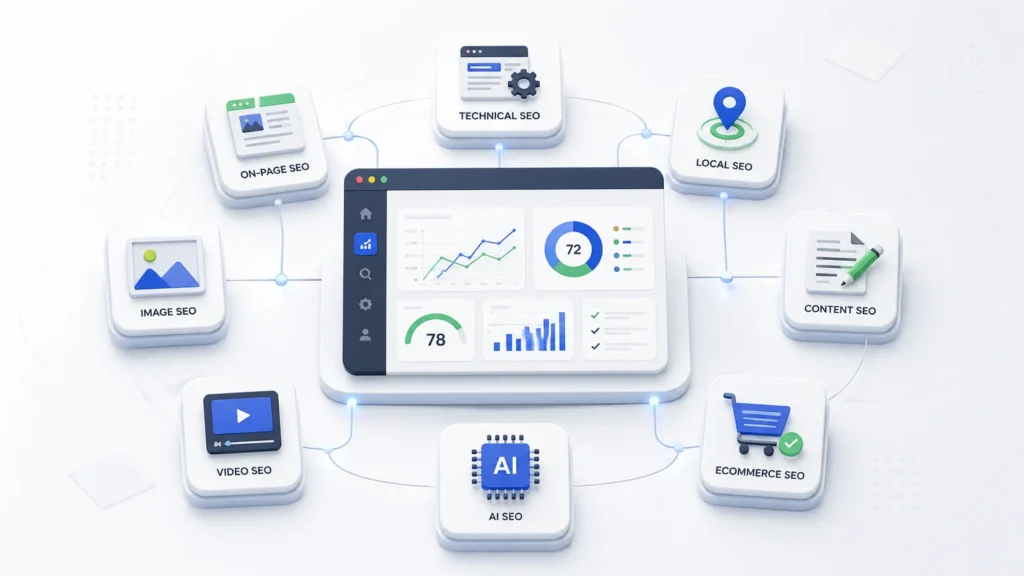
If you are trying to grow a website, you will hear the word “SEO” everywhere. But SEO is not just one task. It is not only adding keywords to a page, writing blogs, or getting backlinks. Search engine optimization is a complete system made of different parts, and each part has a different job.
The main types of SEO are on-page SEO, off-page SEO, technical SEO, and local SEO. These are the foundation. Other important types include content SEO, ecommerce SEO, international SEO, mobile SEO, image SEO, video SEO, and AI SEO. When these work together, your website becomes easier for Google to crawl, easier for users to trust, and easier for AI search systems to understand.
Quick Summary
- On-page SEO helps Google understand what each page is about.
- Off-page SEO builds trust through backlinks, mentions, and reputation.
- Technical SEO makes sure search engines can crawl, index, and read your website properly.
- Local SEO helps businesses rank for searches in a specific city, area, or “near me” result.
- Content SEO helps you create useful pages and articles that answer real search intent.
- Ecommerce SEO helps online stores rank product and category pages.
- AI SEO makes your content easier for Google AI Overviews, ChatGPT, Gemini, Perplexity, and other LLMs to understand.
- The strongest SEO strategy does not depend on one type. It combines the right types based on your website and business goal.
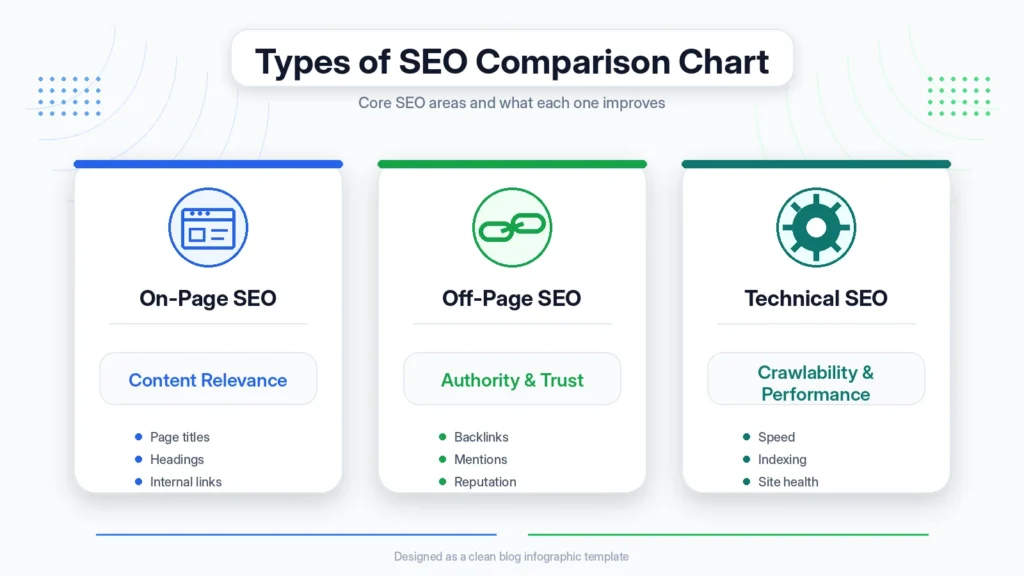
Types of SEO Comparison Table
| Type of SEO | Main Purpose | Best For | Example Task | Priority |
|---|---|---|---|---|
| On-page SEO | Improve individual pages | Blogs, service pages, landing pages | Optimize headings, title, content, and internal links | High |
| Off-page SEO | Build website authority | Competitive industries | Earn backlinks from trusted websites | High |
| Technical SEO | Improve crawlability and indexing | Every website | Fix site speed, sitemap, broken links, and indexing issues | High |
| Local SEO | Improve local visibility | Local businesses | Optimize Google Business Profile and local pages | High for local |
| Content SEO | Create useful search-focused content | Blogs, businesses, publishers | Build guides, topic clusters, and FAQs | High |
| Ecommerce SEO | Rank products and categories | Online stores | Optimize product pages, category pages, and product schema | High for ecommerce |
| International SEO | Target countries and languages | Global websites | Add hreflang and localized pages | Medium |
| Mobile SEO | Improve mobile experience | Every website | Make pages fast, readable, and responsive | High |
| Image SEO | Improve image visibility | Blogs, ecommerce, portfolios | Use alt text, file names, and compressed images | Medium |
| Video SEO | Improve video search visibility | YouTube, education, brands | Add titles, transcripts, thumbnails, and video schema | Medium |
| AI SEO | Help AI systems understand content | Modern search visibility | Add direct answers, schema, FAQs, and clear entities | Growing |
What Are the Main Types of SEO?
The 4 main types of SEO are on-page SEO, off-page SEO, technical SEO, and local SEO. These are the most common SEO categories because they cover the biggest ranking foundations: content relevance, website authority, technical accessibility, and local visibility.
Think of SEO like building a physical store.
Your technical SEO is the road, electricity, doors, and structure. If people and search engines cannot enter properly, nothing else works.
Your on-page SEO is the signboard, product arrangement, labels, and explanations inside the store. It helps visitors understand what you offer.
Your off-page SEO is your reputation outside the store. If people recommend you, review you, and mention you, more people trust you.
Your local SEO is your map location. If someone nearby searches for your service, you want them to find you quickly.
This is why SEO should not be treated as one small task. A page can have good writing but poor technical setup. A website can have good design but no authority. A business can have strong services but poor local visibility. Ranking improves when these parts support each other.
Google’s own guidance explains that SEO is about helping search engines understand your content and helping users decide whether they should visit your site. You can reference Google’s official SEO Starter Guide, Search Essentials, and helpful content guidance.
1. On-Page SEO
What Is On-Page SEO?
On-page SEO is the process of optimizing the content and elements on a webpage so search engines and users can clearly understand the topic. This includes your title, headings, introduction, body content, images, internal links, URL, and meta description.
In simple words, on-page SEO answers this question:
“Is this page clearly about the topic the user searched for?”
If someone searches “types of SEO,” Google wants to show a page that explains the different SEO types clearly. If your page gives a weak definition, confusing headings, and no examples, it will not fully satisfy the searcher.
Why On-Page SEO Matters
On-page SEO matters because Google cannot rank a page properly if the page does not clearly explain its subject. Your content must show relevance.
For example, if a page targets “technical SEO checklist” but mostly talks about general digital marketing, Google may not see it as the best answer. But if the page includes a clear definition, checklist, examples, common issues, FAQs, and related internal links, it becomes more useful.
Good on-page SEO also improves user experience. Readers can scan the page, find answers quickly, understand the topic, and move to the next useful page on your website.
Example of On-Page SEO
Imagine you own a web design agency and publish a page called “SEO Services for Small Businesses.”
A good on-page SEO setup would include:
- A clear title like “SEO Services for Small Businesses”
- A simple introduction explaining what the service includes
- H2 sections for local SEO, technical SEO, content SEO, and monthly reporting
- Real examples of results or use cases
- Internal links to related pages like “Local SEO Services” and “Technical SEO Audit”
- FAQ questions about cost, timeline, and process
- A clear call to action
This helps both users and search engines understand the page.
Common On-Page SEO Tasks
- Write a clear title tag.
- Use one strong H1.
- Structure the page with H2 and H3 headings.
- Use the primary keyword naturally.
- Add related keywords where they fit.
- Write a helpful introduction.
- Add internal links to related pages.
- Add descriptive image alt text.
- Improve readability.
- Add FAQs that answer real user questions.
- Keep the content updated.
Beginner Mistake to Avoid
The biggest mistake is keyword stuffing. Repeating “types of SEO” again and again does not make the article better. It makes it look unnatural. Use the keyword in important places, but write for humans first.
2. Off-Page SEO
What Is Off-Page SEO?
Off-page SEO is everything that happens outside your website that improves your website’s authority, trust, and reputation. The most common part of off-page SEO is backlink building, but it also includes brand mentions, PR, reviews, social visibility, partnerships, and community presence.
In simple words, off-page SEO answers this question:
“Do other trusted sources believe this website is worth recommending?”
Why Off-Page SEO Matters
Search engines do not only look at what you say about yourself. They also look at how the rest of the web responds to your website.
If many trusted websites link to your content, mention your brand, or reference your guides, it becomes a signal that your website has value. This is especially important in competitive niches like SEO, finance, health, technology, education, and ecommerce.
For a new website, off-page SEO usually takes time. You cannot build trust overnight. But consistent publishing, useful resources, digital PR, and relationship-building can slowly improve authority.
Example of Off-Page SEO
Suppose you publish a detailed guide about “types of SEO for small businesses.” Later, a business blog links to your guide in an article about digital marketing basics. A local chamber of commerce also lists your company as a recommended marketing resource. A podcast mentions your article.
These signals help build authority around your website.
Common Off-Page SEO Tasks
- Earn backlinks from relevant websites.
- Publish guest articles.
- Get mentioned in industry blogs.
- Build digital PR campaigns.
- Encourage real customer reviews.
- Create shareable resources.
- Participate in communities.
- Build brand searches.
- Get listed in relevant business directories.
Beginner Mistake to Avoid
Do not buy cheap backlink packages. Spammy backlinks can hurt your website. A few relevant, high-quality backlinks are better than hundreds of low-quality links from random sites.
3. Technical SEO
What Is Technical SEO?
Technical SEO is the process of improving your website’s technical foundation so search engines can crawl, index, render, and understand your pages.
In simple words, technical SEO answers this question:
“Can Google access, read, and process this website properly?”
You can have the best article in your industry, but if Google cannot crawl or index it, it will not rank.
Why Technical SEO Matters
Technical SEO is like the foundation of a building. If the foundation is weak, everything above it becomes unstable.
A website with technical problems may suffer from:
- Pages not getting indexed
- Slow loading speed
- Broken internal links
- Duplicate URLs
- Poor mobile experience
- Crawl errors
- Incorrect canonical tags
- Missing sitemap
- Blocked pages
- Poor site architecture
These issues can stop good content from performing.
Example of Technical SEO
Imagine you publish 50 blog posts, but only 10 appear in Google Search. After checking Google Search Console, you find that many pages are marked “Discovered – currently not indexed.” You also find slow loading pages, weak internal linking, and duplicate tags.
Fixing these issues is technical SEO.
Common Technical SEO Tasks
- Create and submit XML sitemap.
- Check robots.txt.
- Fix indexing issues.
- Improve page speed.
- Use HTTPS.
- Fix broken links.
- Add canonical tags.
- Improve URL structure.
- Optimize Core Web Vitals.
- Make the website mobile-friendly.
- Add structured data where relevant.
- Improve internal linking structure.
Beginner Mistake to Avoid
Do not ignore Google Search Console. It tells you how Google sees your website. Many beginners only look at design and content, but indexing and crawlability are just as important.
4. Local SEO
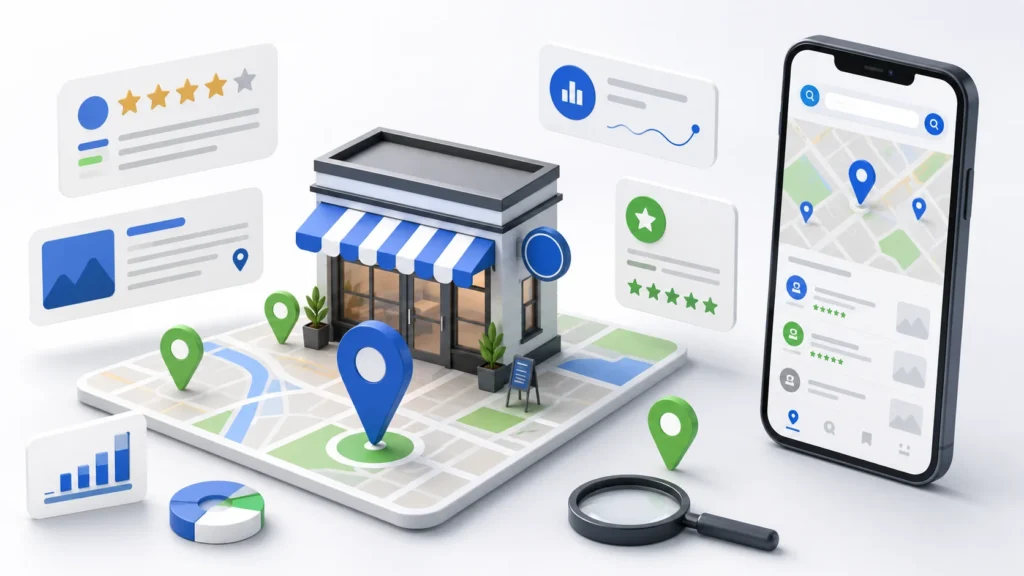
What Is Local SEO?
Local SEO helps your business appear in location-based searches. These include searches like “SEO agency near me,” “best dentist in Hyderabad,” “web designer in Vijayawada,” or “restaurant near me.”
In simple words, local SEO answers this question:
“Is this business relevant, trusted, and near the person searching?”
Why Local SEO Matters
If you serve a specific city or area, local SEO can bring high-intent customers. These people are not just reading. They are often ready to call, visit, book, or buy.
For example, someone searching “emergency plumber near me” does not want a general article about plumbing. They want a nearby service provider quickly.
Local SEO is powerful because it connects your business with people who are already looking for your service in your area.
Example of Local SEO
A local bakery wants to appear for “birthday cake shop near me.” To improve local SEO, the bakery should optimize its Google Business Profile, add correct address and phone number, collect customer reviews, upload real photos, create a location page, and keep business details consistent across directories.
Common Local SEO Tasks
- Optimize Google Business Profile.
- Add correct business name, address, and phone number.
- Choose accurate business categories.
- Add photos and services.
- Collect genuine reviews.
- Create location-specific pages.
- Add local keywords naturally.
- Build local citations.
- Add LocalBusiness schema.
- Keep NAP details consistent everywhere.
Beginner Mistake to Avoid
Do not create fake locations or keyword-stuffed business names. It may look tempting, but it can create trust and compliance problems.
5. Content SEO
What Is Content SEO?
Content SEO is the process of creating and improving content that answers real user questions and matches search intent. It includes blog posts, service pages, guides, case studies, comparison pages, FAQs, and resource hubs.
In simple words, content SEO answers this question:
“Does this content genuinely solve the searcher’s problem?”
Why Content SEO Matters
Search engines rank content because users need answers. If your website does not publish useful content, there are fewer opportunities to rank.
Content SEO is not about writing random blogs. It is about understanding what people search, why they search, and what kind of answer they expect.
For example, a user searching “types of SEO” is probably a beginner. They do not need advanced SEO theory first. They need clear definitions, examples, comparisons, and guidance on where to start.
Example of Content SEO
Instead of publishing one short article called “What is SEO?”, a better strategy is to create a complete SEO topic cluster:
- What is SEO?
- Types of SEO
- On-page SEO checklist
- Technical SEO checklist
- Local SEO guide
- SEO mistakes to avoid
- SEO tools for beginners
- How long does SEO take?
Each article supports the others through internal links. This builds topical authority.
Common Content SEO Tasks
- Research keywords and search intent.
- Create topic clusters.
- Write helpful long-form guides.
- Add examples and original insights.
- Update old content.
- Add FAQs.
- Use internal links.
- Add expert commentary.
- Improve thin pages.
- Remove outdated information.
Beginner Mistake to Avoid
Do not publish content only to fill your blog. Every article should have a purpose, target audience, and search intent.
6. Ecommerce SEO
What Is Ecommerce SEO?
Ecommerce SEO helps online stores rank their product pages, category pages, and buying guides in search results.
In simple words, ecommerce SEO answers this question:
“Can shoppers and search engines easily find, understand, and trust your products?”
Why Ecommerce SEO Matters
Online stores often have hundreds or thousands of pages. Without proper SEO, product pages may become duplicated, thin, slow, or difficult for Google to understand.
Good ecommerce SEO helps bring buyers who are actively searching for products.
Example of Ecommerce SEO
A store selling running shoes should not only optimize individual product pages. It should also improve category pages like “Men’s Running Shoes,” “Women’s Walking Shoes,” and “Best Running Shoes for Beginners.”
Each category page should include useful buying advice, filters, FAQs, product details, reviews, and internal links.
Common Ecommerce SEO Tasks
- Optimize product titles.
- Write unique product descriptions.
- Improve category pages.
- Add product schema.
- Add review schema where valid.
- Optimize product images.
- Fix duplicate URLs.
- Improve faceted navigation.
- Add buying guides.
- Improve site speed.
- Use internal links between related products.
Beginner Mistake to Avoid
Do not copy product descriptions from manufacturers. If many websites use the same description, your page has little unique value.
7. International SEO
What Is International SEO?
International SEO helps websites target users in different countries, languages, or regions.
In simple words, international SEO answers this question:
“Which version of this page should appear for which country or language?”
Why International SEO Matters
If your website serves multiple countries, search engines need clear signals. A user in India, the US, and the UK may use different words, currencies, examples, and expectations.
International SEO is not just translation. It is localization.
Example of International SEO
A software company may create separate pages for:
- India: pricing in INR and Indian business examples
- USA: pricing in USD and US compliance language
- UK: British spelling, local examples, and GBP pricing
Hreflang tags help search engines understand the correct regional version.
Common International SEO Tasks
- Add hreflang tags.
- Create localized pages.
- Use correct country or language URL structure.
- Translate naturally.
- Localize examples, currency, and spelling.
- Avoid duplicate international pages.
- Use region-specific keyword research.
Beginner Mistake to Avoid
Do not rely only on automatic translation. Translated content can miss local search intent.
8. Mobile SEO
What Is Mobile SEO?
Mobile SEO ensures that your website works well on smartphones and tablets.
In simple words, mobile SEO answers this question:
“Can mobile users read, navigate, and use this page easily?”
Why Mobile SEO Matters
Most users search from mobile devices. If your website is slow, difficult to read, or hard to tap on mobile, users will leave.
A poor mobile experience can reduce engagement, leads, and conversions.
Example of Mobile SEO
A service page may look beautiful on desktop, but on mobile the text may be too small, buttons may be hard to tap, and images may load slowly. Mobile SEO fixes those problems.
Common Mobile SEO Tasks
- Use responsive design.
- Improve mobile page speed.
- Use readable font sizes.
- Make buttons easy to tap.
- Avoid intrusive popups.
- Compress images.
- Test layouts on multiple devices.
- Keep navigation simple.
Beginner Mistake to Avoid
Do not approve your website only by checking it on a laptop. Always test it on mobile.
9. Image SEO
What Is Image SEO?
Image SEO helps search engines understand your images and helps images appear in Google Images and rich search results.
In simple words, image SEO answers this question:
“Can search engines understand what this image shows?”
Why Image SEO Matters
Images improve user experience, explain ideas faster, and can bring additional traffic. This is especially important for ecommerce, recipes, education, travel, real estate, fashion, and design websites.
Example of Image SEO
For this article, an image file named types-of-seo-comparison-chart.webp is more useful than IMG_9876.png.
Good alt text would be:
“Comparison chart showing different types of SEO including on-page, off-page, technical, local, and AI SEO.”
Common Image SEO Tasks
- Use descriptive file names.
- Add accurate alt text.
- Compress large images.
- Use WebP format where possible.
- Add captions when helpful.
- Use original diagrams.
- Make images responsive.
Beginner Mistake to Avoid
Do not stuff alt text with keywords. Alt text should describe the image clearly.
10. Video SEO
What Is Video SEO?
Video SEO improves the visibility of videos in Google Search, YouTube, and other video platforms.
In simple words, video SEO answers this question:
“Can users and search engines understand what this video is about?”
Why Video SEO Matters
Some topics are easier to understand through video. For example, “how to do a technical SEO audit” may work better with a screen recording than only text.
Videos can also increase time on page and help your brand feel more trustworthy.
Example of Video SEO
You can create a 3-minute video explaining “on-page vs off-page vs technical SEO” and embed it inside this article. Add a transcript below it so search engines and users can read the content.
Common Video SEO Tasks
- Use keyword-focused video titles.
- Add detailed descriptions.
- Add transcripts.
- Use timestamps.
- Create custom thumbnails.
- Add captions.
- Embed videos near relevant text.
- Use video schema when appropriate.
Beginner Mistake to Avoid
Do not upload a video with no title, no description, and no transcript. Search systems need context.
11. AI SEO / Generative Search SEO
What Is AI SEO?
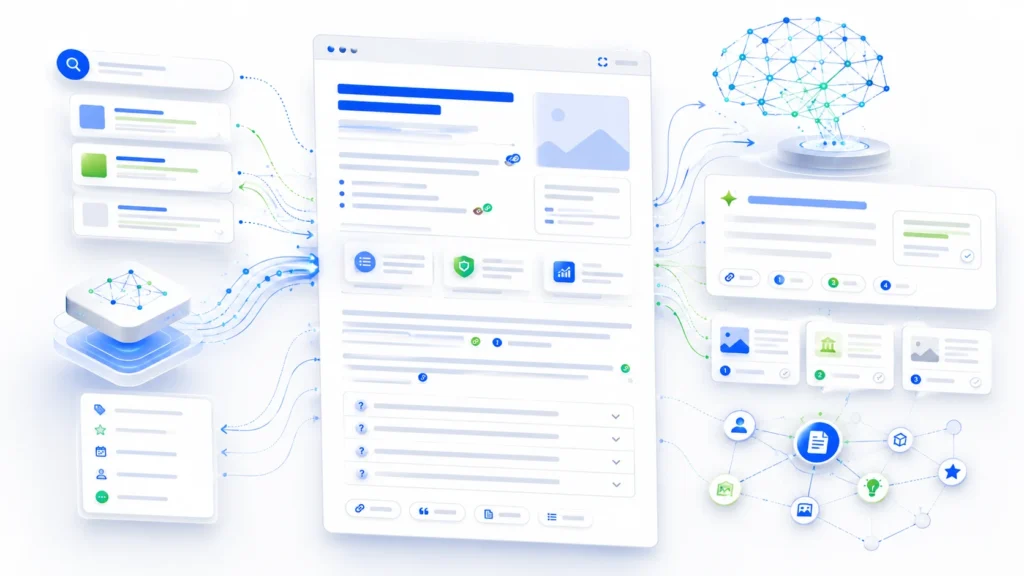
AI SEO is the process of making your content easier for AI search systems and large language models to understand, summarize, and reference.
This matters for Google AI Overviews, AI Mode, ChatGPT, Gemini, Perplexity, Claude, and other answer engines.
In simple words, AI SEO answers this question:
“Can an AI system clearly understand the topic, facts, structure, and usefulness of this page?”
Why AI SEO Matters
Search is changing. Users are no longer only clicking blue links. They are asking full questions and receiving summarized answers from AI systems.
Google has also stated that traditional SEO best practices still apply to generative AI search because AI features are rooted in core Search systems. That means AI SEO should not replace normal SEO. It should improve it.
Example of AI SEO
A page is easier for AI systems to understand when it includes:
- Clear definitions
- Short direct answers
- Comparison tables
- FAQ sections
- Structured headings
- Real examples
- Trusted external references
- Schema markup
- Updated information
This article structure is built in that format.
Common AI SEO Tasks
- Add direct answer blocks.
- Use clear headings.
- Define important terms.
- Include examples.
- Add FAQ sections.
- Use schema markup.
- Cite reliable sources.
- Avoid vague claims.
- Keep content organized.
- Build topical authority across multiple pages.
Beginner Mistake to Avoid
Do not write only for AI. Your first priority is still helping real people. AI search systems are more likely to understand content that is already clear and useful for humans.
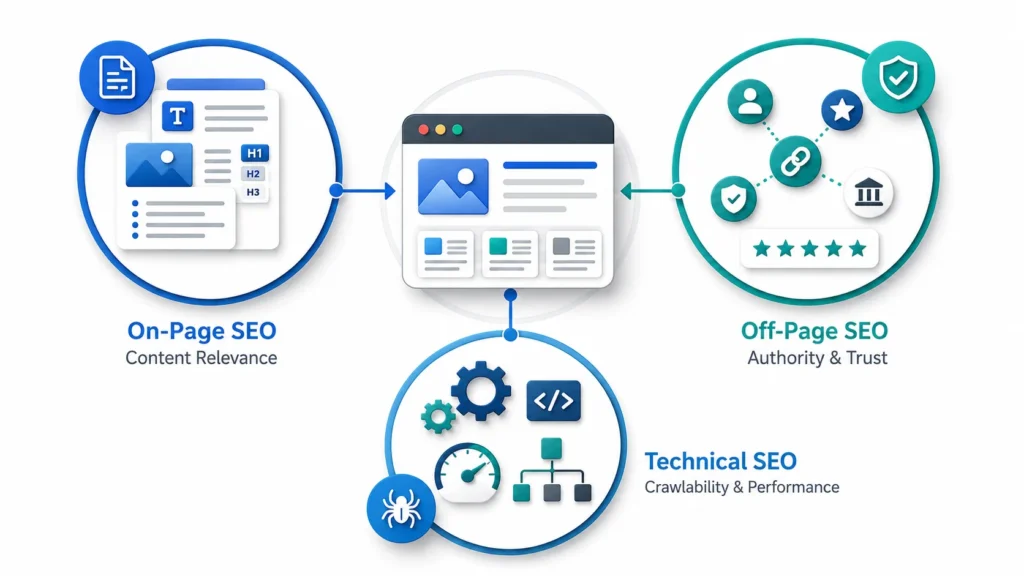
On-Page vs Off-Page vs Technical SEO
Many beginners get confused between on-page, off-page, and technical SEO. Here is the simplest way to understand the difference.
| SEO Type | Simple Meaning | Example |
|---|---|---|
| On-page SEO | Improve the page itself | Better headings, content, title, internal links |
| Off-page SEO | Improve trust outside your website | Backlinks, mentions, reviews, PR |
| Technical SEO | Improve website access and performance | Indexing, speed, sitemap, crawlability |
A strong website needs all three.
On-page SEO tells Google what your content is about. Technical SEO helps Google access and process the content. Off-page SEO helps Google trust the content.
If one part is weak, the whole strategy becomes weaker.
Which Type of SEO Should You Start With First?
The best SEO type to start with depends on your website’s current situation. A new website does not need the same priority as an ecommerce store. A local business does not need the same strategy as an international SaaS company.
| Website Type | Start With | Why |
|---|---|---|
| New website | Technical SEO + on-page SEO | Google must crawl and understand your pages first |
| Local business | Local SEO + on-page SEO | You need visibility in city and “near me” searches |
| Ecommerce store | Ecommerce SEO + technical SEO | Product and category pages need strong structure |
| Blog | Content SEO + on-page SEO | Blogs grow through helpful articles and topic clusters |
| Service business | On-page SEO + local SEO | Service pages must clearly explain offers and locations |
| International website | International SEO + technical SEO | Search engines need country and language signals |
| Website with low traffic | Content SEO + internal linking | More useful content creates more ranking opportunities |
| Website with indexing issues | Technical SEO | Pages cannot rank if they are not indexed |
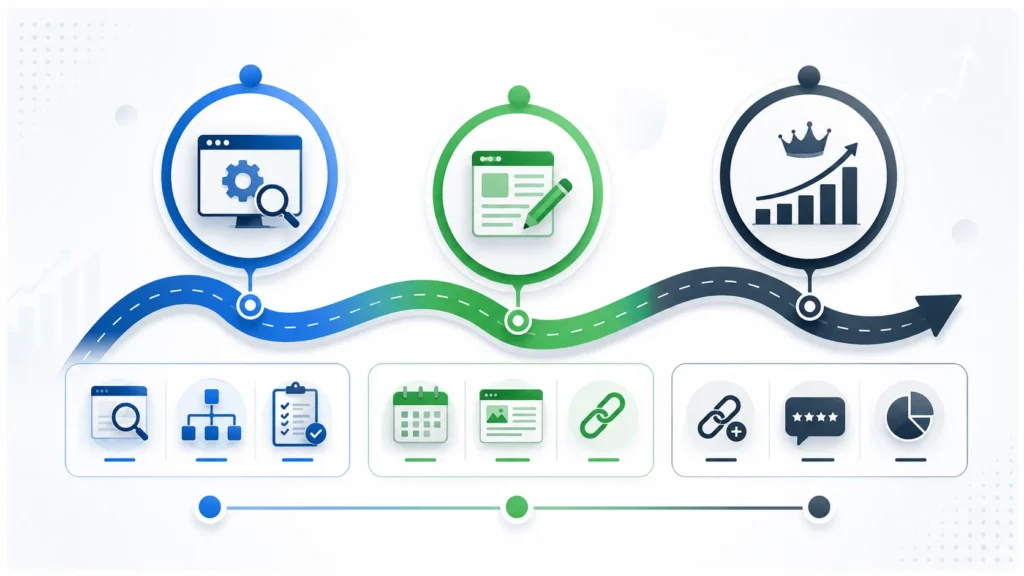
A Simple 90-Day SEO Roadmap for Beginners
If you are starting SEO now, do not try to do everything in one week. Follow a simple order.
Days 1-30: Fix the Foundation
- Set up Google Search Console.
- Submit your sitemap.
- Check indexing issues.
- Fix broken links.
- Improve page speed.
- Make sure your website is mobile-friendly.
- Optimize your main service or product pages.
Days 31-60: Build Better Content
- Research low-competition long-tail keywords.
- Publish helpful articles.
- Add internal links between related pages.
- Improve old thin content.
- Add FAQs.
- Add comparison tables and examples.
Days 61-90: Build Authority
- Promote your best content.
- Reach out for backlinks.
- Get listed in relevant directories.
- Collect customer reviews.
- Publish guest posts.
- Build topical authority with supporting articles.
This roadmap works because it follows the natural order: first make the site accessible, then make it useful, then make it trusted.
Types of SEO Checklist for Beginners
Use this checklist before publishing any important page:
- Choose one primary keyword.
- Understand the search intent.
- Write a clear H1.
- Add a direct answer near the top.
- Use helpful H2 and H3 headings.
- Explain the topic with examples.
- Add internal links to related pages.
- Add external links to trusted sources.
- Use descriptive image names.
- Add accurate alt text.
- Improve page speed.
- Make the page mobile-friendly.
- Add FAQ section.
- Add schema markup where relevant.
- Check indexing in Google Search Console.
- Update the page when information changes.
Common SEO Mistakes Beginners Should Avoid
1. Writing for Keywords Instead of People
Keywords are important, but the reader matters more. If the page does not help the reader, it will not build trust.
2. Ignoring Technical SEO
Many websites publish content for months without checking if Google is indexing the pages. This is a costly mistake.
3. Publishing Thin Content
A 500-word article may rank in some cases, but competitive topics usually need depth, examples, and better structure.
4. Forgetting Internal Links
Internal links help users discover related content and help search engines understand your site structure.
5. Building Low-Quality Backlinks
Cheap backlinks can damage trust. Focus on relevance and quality.
6. Not Updating Old Content
SEO changes. Your content should be refreshed when examples, tools, or best practices change.
FAQ
What are the main types of SEO?
The main types of SEO are on-page SEO, off-page SEO, technical SEO, and local SEO. These four types form the foundation of most SEO strategies because they improve content relevance, authority, crawlability, and local visibility.
What are the 4 types of SEO?
The 4 types of SEO are on-page SEO, off-page SEO, technical SEO, and local SEO. On-page SEO improves website pages, off-page SEO builds authority, technical SEO improves crawling and indexing, and local SEO improves location-based rankings.
Which type of SEO is most important?
Technical SEO and on-page SEO are usually the most important starting points because your site must be accessible and understandable before it can rank well. For local businesses, local SEO is also very important.
What is the difference between on-page and off-page SEO?
On-page SEO focuses on things you control on your website, such as content, headings, title tags, images, and internal links. Off-page SEO focuses on signals outside your website, such as backlinks, brand mentions, reviews, and digital PR.
Is technical SEO necessary?
Yes, technical SEO is necessary. If search engines cannot crawl, index, or understand your pages, your content may not appear in search results. Technical SEO supports every other type of SEO.
What type of SEO is best for small businesses?
For most small businesses, local SEO, on-page SEO, and technical SEO are the best starting points. These help the business appear in local searches, explain services clearly, and make the website easier for Google to process.
What is AI SEO?
AI SEO is the process of making your content easier for AI search systems and LLMs to understand. It includes clear answers, structured headings, FAQs, schema markup, examples, trusted sources, and helpful content written for real users.
How many types of SEO are there?
There is no fixed number, but the most common types include on-page SEO, off-page SEO, technical SEO, local SEO, content SEO, ecommerce SEO, international SEO, mobile SEO, image SEO, video SEO, and AI SEO.
Conclusion
SEO is not one single technique. It is a complete system that helps your website become easier to find, easier to understand, and easier to trust.
If you are a beginner, start with technical SEO and on-page SEO. If you run a local business, add local SEO. If you run an online store, focus on ecommerce SEO. If you want long-term growth, build content SEO and off-page authority. And if you want to prepare for the future of search, structure your content for AI SEO and generative search systems.
The websites that perform best are not always the ones with the most content. They are the ones that answer real questions clearly, provide useful examples, build trust, and make it easy for both people and search engines to understand their value.
Source Links To Cite
Use these as external references inside the article: