Krishna digital art images are artworks of Lord Krishna and Radha Krishna that are created or finished on a computer and delivered as image files rather than as painted canvases. People set them as 4K wallpapers, display them on smart TVs and digital photo frames, use them in pooja and meditation rooms, and print them for personal spaces.
That definition is simple. The decisions around it are not. A file that looks beautiful on a phone screen can fall apart on a 55-inch television. An image saved from a social feed may be a fraction of the size it appears. And a picture you love may carry a licence that quietly forbids the thing you were planning to do with it.
This guide walks through the styles of Krishna art people search for most, what true 4K resolution actually delivers on screens and in prints, how to judge quality and licensing before you download anything, and — openly — the 25-piece collection our team has put together.
What Are Krishna Digital Art Images?
Krishna digital art images are devotional artworks of Lord Krishna, Radha Krishna and related scenes that exist as digital image files — usually PNG or JPEG — created using digital painting, illustration, photo-compositing or digitally-refined AI-assisted tools.
The important distinction is medium, not subject. A traditional Lord Krishna painting is a physical object: pigment on canvas, cloth or paper, existing once, hanging in one place. A Krishna digital artwork is a file. It can be displayed on any screen you own, reproduced without wearing out, resized within limits, and delivered to you in seconds instead of shipped in a crate.
That brings real advantages. It also brings a category of question that never applies to a framed picture: what are the pixel dimensions, what shape is it, what am I permitted to do with it, and will it still look good when I make it big?
Three practical differences worth holding on to:
- A digital artwork has a fixed pixel size. You can shrink it freely. Enlarging it beyond its native dimensions softens it.
- A digital artwork has a fixed shape. A landscape file placed on a portrait screen will be cropped or letterboxed.
- A digital artwork comes with a licence. Buying a print gives you an object. Buying a file gives you defined permission to use it.
Popular Styles of Lord Krishna Digital Art
Search interest in Lord Krishna digital art clusters around a small number of much-loved themes. Most collections are built from these.
Krishna Playing the Flute
The single most recognisable image in Krishna art. The flute, the peacock feather, the tribhanga stance — the gently bent posture at neck, waist and knee. Digitally, this theme suits soft light, warm evening tones and shallow depth, letting the figure sit forward while Vrindavan blurs behind. It is the theme most people mean when they simply search for Krishna artwork.
Radha Krishna Digital Art
Radha and Krishna together, treated as an image of devotion and union. This is the busiest area of the whole category — a radha krishna digital art wallpaper is one of the most-requested devotional downloads there is. Compositions vary widely: quiet garden scenes, silhouettes against a full moon, close portraits, monsoon settings under a shared shelter.
Vrindavan Landscapes
Here the setting carries the devotion rather than a central figure. Kadamba trees, the Yamuna at dusk, lotus ponds, temple silhouettes, forest paths. These work exceptionally well as ambient wallpapers and TV art, because there is no face demanding your attention every time you glance at the screen.
Bal Krishna and Cute Krishna Art
Baby Krishna and childhood scenes — the butter thief, the crawling infant with an anklet, the small boy with an oversized peacock crown. Rendered in soft, rounded, warm-lit styles, this is what people are looking for when they search cute krishna digital art prints. It is a common choice for children’s rooms and for smaller framed pieces near a home shrine.
Krishna with Peacocks and Sacred Cows
Peacocks, cows, deer and birds recur throughout Krishna imagery and carry strong associations with Vrindavan and with Krishna as Govinda, the protector of cows. Visually, they give an artist a second focal point and a natural way to fill a wide landscape frame without crowding the central figure.
Krishna and Arjuna Artwork
Scenes drawn from the setting of the Bhagavad Gita — the chariot on the battlefield of Kurukshetra, Krishna as Arjuna’s charioteer and guide. The mood here is different from the Vrindavan themes: weightier, more dramatic, often stormier in palette. These pieces suit a study or a personal reading space more naturally than a nursery.
Modern and Cinematic Krishna Digital Art
A contemporary treatment of traditional subjects: cinematic lighting, atmospheric haze, rim light, richer contrast, a filmic colour grade. The iconography stays traditional — flute, feather, blue complexion, yellow pitambara — while the rendering borrows from modern illustration and concept art. This is the fastest-growing look in devotional digital art, and it is why so many searches now specify modern.
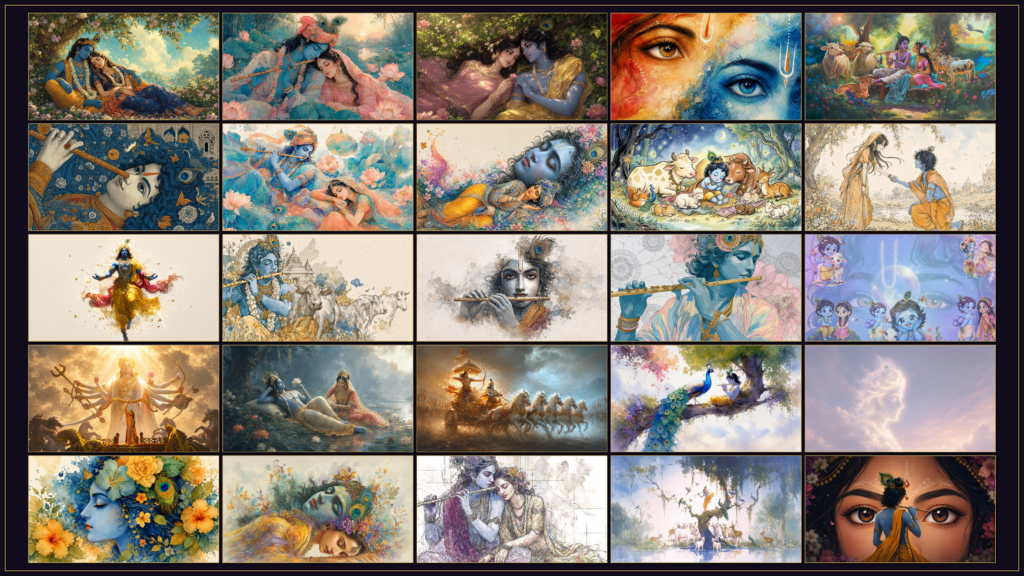
If you would like to see how these themes look when they are treated as one consistent set rather than assembled from different sources, you can explore the 25-piece Krishna digital art collection our team put together. The rest of this guide applies whether you buy it or not.
Why Choose Krishna Digital Art in 4K?
A krishna digital art 4k wallpaper means a specific, checkable thing: an image measuring 3840 × 2160 pixels, in a 16:9 landscape shape. That is the consumer 4K UHD standard — around 8.3 million pixels, exactly four times the pixel count of Full HD (1920 × 1080), and the resolution used by essentially every 4K television and monitor sold today. The Consumer Technology Association defines 4K Ultra High-Definition TV around this same 3840 × 2160, 16:9-or-wider baseline.
Why it matters in practice:
- Large screens reveal weakness. On a phone, a 1280 × 720 image can pass. On a 55- or 65-inch television, the same file is stretched across roughly nine times the area and the softness becomes obvious in exactly the places you notice most — the edge of a face, the fine line of a flute, the detail in an embroidered border.
- Desktops are already there. 4K monitors and laptop panels are now ordinary. A native 3840 × 2160 file maps pixel-for-pixel onto a 4K display with nothing invented and nothing lost.
- Digital frames vary. Many are 1920 × 1080 or lower. A 4K file downscales onto them cleanly — downscaling is always safe. The thing to check on a digital frame is shape, not size: a portrait-oriented frame will crop a 16:9 landscape image significantly.
Resolution is not the same as print quality
This is where most buyers of devotional art get caught, and where almost no page on the subject helps them.
Pixel count alone does not determine print size. What determines print size is pixels divided by print density (PPI). Photographic-grade printing generally targets around 300 PPI. Wall art viewed from a metre or more away is commonly printed at 150–200 PPI and still looks excellent, because your eye simply cannot resolve the difference at that distance.
Here is what 3840 × 2160 works out to:
| Print density | Print size (inches) | Print size (cm) | Realistic use |
|---|---|---|---|
| 300 PPI | 12.8 × 7.2 in | 32.5 × 18.3 cm | Sharp small framed print, close viewing |
| 240 PPI | 16 × 9 in | 40.6 × 22.9 cm | Comfortable desk or shelf frame |
| 200 PPI | 19.2 × 10.8 in | 48.8 × 27.4 cm | Medium wall print, normal viewing distance |
| 150 PPI | 25.6 × 14.4 in | 65 × 36.6 cm | Large panel viewed from a metre or more |
So a 4K file is genuinely capable as a small-to-medium landscape print. It is not the right source for a large portrait-format canvas — that would need either far more pixels or a different aspect ratio, and no amount of enlargement software changes the underlying arithmetic.
Always confirm dimensions with your printing provider before ordering. Printers differ in what density they require, papers absorb ink differently, and colours on a backlit screen never match ink on paper exactly. Blues and golds — precisely the colours Krishna art depends on — are among the most likely to shift.
Where Can Krishna Digital Art Be Used?
A 16:9 devotional wallpaper is more versatile than it first appears, provided the use suits a landscape shape.
- Desktop and laptop wallpapers. The most direct fit. A 3840 × 2160 file matches 4K displays natively and scales down cleanly to 1080p.
- Smart TVs. Most modern televisions have an art, ambient or photo mode. A 4K devotional image displayed there turns an idle black rectangle into something considered — especially effective in a living room during festival days.
- Digital photo frames. Excellent, provided the frame is landscape-oriented. Check the frame’s aspect ratio first.
- Prayer and meditation rooms. A quiet screen displaying a Vrindavan landscape or a Radha Krishna scene can sit comfortably in a meditation space without the permanence of a mounted frame.
- Pooja rooms. Many households now keep a small screen or tablet alongside traditional images. A rotating set of artworks suits daily and festival use.
- Personal wall prints. Well within reach at the sizes shown in the table above — confirm dimensions with your printer first.
- Krishna Janmashtami digital decoration. Janmashtami falls on Friday, 4 September 2026 (some Vaishnava traditions observe it on 5 September). A television or projector cycling through devotional artwork is a practical addition to home decoration, and unlike printed banners it can be reused every year.
- Personal presentations and spiritual projects. Personal bhajan slides, family study material, a home satsang backdrop.
One honest constraint: these are landscape files. For a phone lock screen or a portrait digital frame, a 16:9 image must be cropped, and cropping a devotional composition can cut through the very part you wanted centred. That is a limitation of the format, not a defect — but it is worth knowing before you buy anything advertised as 16:9.
Note also that a personal-use licence covers personal display only. Temple screens, community-hall projection, commercial premises, printed merchandise, resale and paid events fall outside it. More on that below.
How to Choose the Best Krishna Digital Art
“Best” is not a fixed property of an artwork. The best krishna digital art is whichever collection matches the screen you own, the space you are decorating and the permissions you need. Run any seller — including us — through this checklist.
- Resolution, stated as a number. Look for actual pixel dimensions, not the word “HD”. If a page says “4K” without ever printing “3840 × 2160”, ask why.
- Aspect ratio. 16:9 for televisions and desktops. Portrait or square for phones and portrait frames. Getting this wrong causes more disappointment than resolution ever does.
- File format. PNG preserves detail without compression artefacts and is a sound choice for artwork that may be printed. High-quality JPEG is acceptable; heavily compressed JPEG shows blocking in smooth gradients like skies and skin.
- Watermarks. Delivered files should be clean. A watermarked preview is normal and fair; a watermarked final file is not.
- Artistic consistency. Does the set look as though it belongs together — one palette, one hand, one lighting approach? Twenty-five images gathered from twenty-five different sources will never sit well side by side on a wall or in a slideshow.
- Download method. Instant delivery after payment is standard for digital goods. Know whether you are receiving individual files or an archive.
- Licence terms. Read them before paying, not after. Personal-use licences are common and perfectly reasonable — but you need to know what they exclude.
- Seller transparency. A findable seller with a contact route, a stated refund policy and honest product descriptions. Note whether AI-assisted tools were used; in 2026, disclosure is a mark of good faith, not a weakness.
- Cultural respect. Check that iconography is handled with care — that Lord Krishna, Radha and sacred symbols are depicted respectfully rather than used as decorative motifs stripped of meaning.
- Print compatibility. If you plan to print, work backwards from the size you want using the PPI table above, then confirm with your printing provider.
A note on where people find Krishna art
Most people’s first encounter with a piece of Krishna artwork is on a visual discovery platform — a saved pin, a screenshot, a re-shared image. Searching krishna digital art on Pinterest will surface thousands of beautiful compositions, and that is a legitimate way to work out which styles move you.
What it does not give you is a usable file. A saved pin is usually a small, re-compressed copy several steps removed from the original, with the artist’s name lost somewhere along the chain and no licence attached. Use those platforms for inspiration, then obtain the actual artwork from a source that states its resolution, its format and its terms — whether that is a stock library, an independent artist, or a collection like ours.
Modern Radha Krishna Digital Art and Traditional Devotional Themes
There is an assumption worth setting aside: that contemporary rendering somehow dilutes traditional devotional art.
Devotional imagery in India has never been visually static. Pichwai paintings of Nathdwara, Pahari miniatures, Tanjore work with its gold leaf and gemstones, Kalighat’s swift bold line, Madhubani’s dense patterning, and the printed calendar art of the twentieth century — each generation has depicted the same beloved subjects using the materials and visual language available to it. Modern radha krishna digital art continues that line rather than breaking from it.
What changes is the surface. What holds steady is the iconography — the flute, the peacock feather, the yellow pitambara, the lotus, Radha’s presence beside Krishna. When a digital artwork keeps those anchors intact, it reads as devotional to anyone raised with the tradition, regardless of whether the light was mixed in oil paint or rendered on a screen.
This is also why terminology varies: Shree Krishna digital art, Shri Krishna, Sri Krishna and Lord Krishna all refer to the same subject, with the honorific transliterated differently across regions and languages. If a search does not return what you expect, try another spelling.
Our own approach across the collection is to keep traditional iconography and treat it with modern light — deeper contrast, atmospheric depth, cinematic warmth — without altering the symbols themselves.
Introducing the Divine Visions of Krishna Collection
This is our own product. We are describing it directly rather than reviewing it.
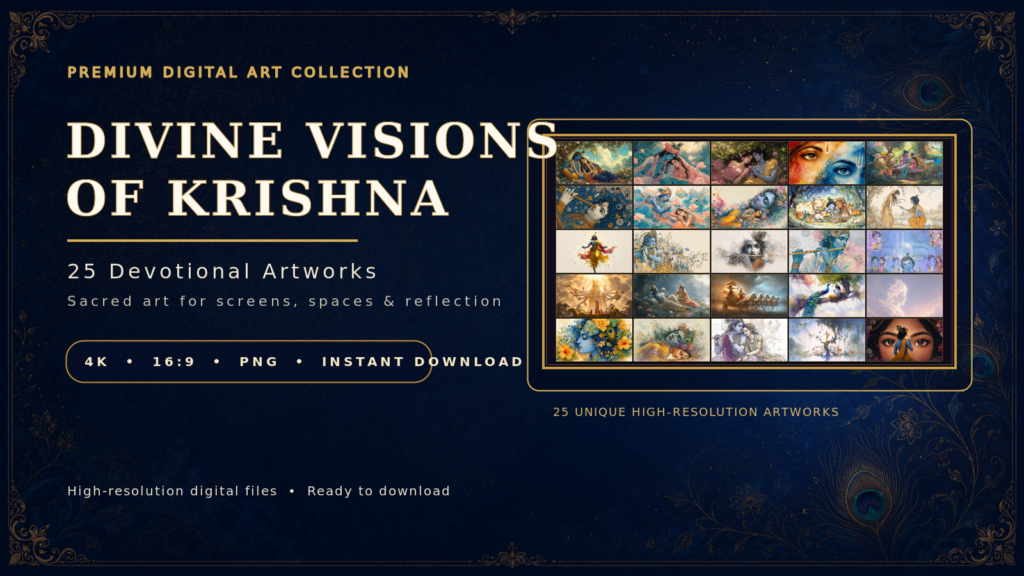
Divine Visions of Krishna is a 25-piece downloadable collection of Krishna and Radha Krishna artworks, prepared at exact 4K resolution in a consistent visual style, and delivered as an instant digital download.
| Specification | Detail |
|---|---|
| Number of artworks | 25 |
| Resolution | 3840 × 2160 pixels |
| Aspect ratio | 16:9 |
| Format | PNG |
| Orientation | Horizontal (landscape) |
| Delivery | Instant digital download |
| Licence | Personal use |
| Physical delivery | No — nothing is shipped |
Themes across the 25 pieces include Lord Krishna playing the flute; Radha and Krishna in peaceful Vrindavan settings; Krishna with peacocks, cows, deer and birds; lotus ponds and spiritual landscapes; Bal Krishna and baby Krishna scenes; Krishna and Arjuna, drawing on the setting of the Bhagavad Gita; Vishvarupa and celestial devotional scenes. Styles range across watercolour, illustrated and cinematic digital treatments.
Where it fits well: 4K desktop and laptop wallpapers; smart-TV art and ambient modes; landscape digital frames; pooja, meditation and yoga rooms; Janmashtami digital decoration; personal presentations; and personal prints at the sizes given in the print table above.
Where it fits less well, stated plainly: phone lock screens and portrait-format frames, because every file is 16:9 landscape. And large portrait wall canvases, for the pixel reasons already covered.
On how the artwork was made: some pieces in this collection were created or enhanced using AI-assisted digital-art tools and then digitally refined. We state this openly because you deserve to know what you are buying, and because the same disclosure appears on the product page itself.
On reviews: the collection is new and has no customer reviews yet. We would rather say so than manufacture social proof.
You can view the Krishna 4K digital art bundle for full previews, the current price and the complete licence. Buyers outside India who prefer to pay in USD can use the international checkout on Gumroad.
What Is Included in the Download?
Based on the product’s published specifications, your purchase includes:
- 25 individual Krishna and Radha Krishna digital artworks
- Exact 4K resolution: 3840 × 2160 pixels per artwork
- Horizontal 16:9 aspect ratio throughout
- High-quality PNG files
- Clean delivered artwork with no logos or watermarks
- One downloadable ZIP collection
- Instant access after successful payment
- A personal-use licence
No physical frame, canvas, poster or printed item is shipped. This is a digital product only.
How to Download the Krishna Art Collection
- Visit the product page — the Mega Dukanam page for INR payment, or Gumroad for international checkout.
- Review the previews and the licence before you commit. Confirm that 16:9 landscape suits your intended display.
- Choose your checkout option and add the collection to your cart.
- Complete payment through the store’s checkout.
- Access the download link provided after payment completes.
- Download and extract the ZIP file to your computer. Extracting on a desktop or laptop is easiest; some mobile devices need a separate file-management app to open archives.
Downloading a large 4K collection over a slow or unstable connection can fail partway through. If a file appears damaged or a link does not work, contact the store’s support rather than re-purchasing.
Personal-Use Licence Explained
The standard licence for this collection is personal use. In plain language, that means the artwork is for you, in your own home and on your own devices.
Under the personal-use licence you may:
- Use the artwork on your personal devices — computers, laptops, tablets
- Display it on your own smart TV or digital photo frame
- Create prints for your own home or personal devotional space
- Use it for your own Krishna Janmashtami decoration
You may not:
- Resell or redistribute the original files
- Share the download with other people
- Upload the files to stock-art or wallpaper websites
- Include the images in another digital-art bundle
- Sell physical products carrying the artwork
- Use the artwork in commercial advertising, merchandise or NFTs
- Claim authorship or exclusive ownership of the artwork
The useful test is straightforward: personal display is fine; distribution and commercial gain are not.
If your intended use falls outside this — a business, a printed product line, a public venue, a paid event — a personal licence does not cover it, and no article can grant you permission it doesn’t have. Contact the seller to ask whether a commercial licence is available. Please read the complete licence text on the product page before purchasing; the wording there governs, and this summary is provided for clarity, not as legal advice.
Frequently Asked Questions
What are Krishna digital art images? Krishna digital art images are artworks of Lord Krishna and Radha Krishna created or finished digitally and delivered as image files rather than physical paintings. They are used as wallpapers, smart-TV and digital-frame displays, and personal prints. Unlike a painted canvas, each file has fixed pixel dimensions, a fixed aspect ratio and a licence defining permitted use.
Can I use Krishna digital art as a desktop wallpaper? Yes. Desktop and laptop wallpaper is the most natural use for landscape devotional artwork. A 3840 × 2160 file maps directly onto a 4K monitor and scales down cleanly to 1080p and 1440p displays. On ultrawide monitors, a 16:9 image will show side bars or require cropping, since ultrawide panels use a wider ratio.
Are the Krishna artworks available in 4K? Yes. Every artwork in the Divine Visions of Krishna collection is prepared at exactly 3840 × 2160 pixels — the consumer 4K UHD standard — in a 16:9 horizontal format, supplied as PNG. That is roughly 8.3 million pixels per image, four times the pixel count of a Full HD file, with no upscaling from a smaller source.
Can I display the images on a smart TV? Yes. Most smart TVs include an art, ambient or photo mode that displays still images, and a 4K television matches 3840 × 2160 exactly. You can usually load images via USB drive, a connected media app, or your TV’s own photo feature. Check your specific television’s manual for supported formats and the recommended loading method.
Can I print the Radha Krishna digital art? Yes, for personal use. A 3840 × 2160 file prints sharply at around 12.8 × 7.2 inches at 300 PPI, and up to roughly 25.6 × 14.4 inches at 150 PPI for wall art viewed from a distance. All files are landscape, so portrait frames need cropping. Always confirm dimensions and colour handling with your printing provider first.
Is this a physical or digital product? It is entirely digital. Nothing is shipped. There is no printed poster, framed picture or canvas in the purchase. After payment completes you receive access to a downloadable ZIP file containing the 25 artworks, which you download to your own device. If you want a physical print, you arrange that yourself with a printing provider.
Can I use the artwork commercially? No. The standard licence is personal use only. It does not permit merchandise, printed products for sale, commercial advertising, NFTs, business or public-venue display, or paid events. If you need commercial rights, contact the seller to ask whether a commercial licence is available. Please read the full licence on the product page before purchasing.
Can I share or resell the downloaded files? No. Sharing the download with other people, reselling the files, redistributing them, uploading them to stock or wallpaper sites, and including them in another digital bundle are all outside the personal-use licence. The purchase covers you and your own household devices. Each person who wants the collection needs their own purchase.
What is included in the Krishna digital-art bundle? Twenty-five individual Krishna and Radha Krishna artworks, each at 3840 × 2160 pixels in 16:9 landscape, supplied as high-quality PNG files with no logos or watermarks, delivered as one downloadable ZIP collection with instant access after payment, under a personal-use licence. No physical item is included or shipped.
How do I download the files after purchasing? After your payment completes, a download link is provided. Open the link, download the ZIP file, then extract it on your device to access all 25 artworks. Extracting is simplest on a computer; some phones need a separate file-manager app. If a download fails or a file appears damaged, contact the store’s support team.
Final Thoughts
Choosing devotional artwork for a home is a small act of care. It deserves the same attention you would give a printed picture you intend to hang for years — which, in the digital case, means checking three things before anything else: the actual pixel dimensions, the aspect ratio against the screen or frame you own, and the licence.
Good krishna digital art images repay that attention. At 3840 × 2160 they hold up on a large television, sit cleanly on a 4K desktop, and print well at the sizes the arithmetic supports. A consistent set does something a folder of assorted downloads cannot: it holds together, so that whichever image appears, it looks as though it belongs.
If a curated collection along these lines suits your space, you can see all Krishna and Radha Krishna artworks with full previews, current pricing and the complete licence terms, or view the collection on Gumroad for international checkout. And if you decide it isn’t right for you, the checklist above will serve you just as well with any other seller.
About the author
Ravula Charan is the creator and publisher of RC Blog and of Mega Dukanam, a digital-products marketplace, and curated the Divine Visions of Krishna collection described in this article. He writes about digital products, web technology and SEO. About the author · Contact
Sources and further reading
- Consumer Technology Association — Video Technology: Consumer Definitions (4K UHD display characteristics)
- Krishna.com — Paintings gallery and usage guidelines (an example of clearly stated devotional-art usage terms)
- Product licence and full specifications