You search Google for a pair of running shoes.
You open one of the results, look at a few products, and leave without buying anything.
Later that evening, you notice the same brand while scrolling through Instagram. The next day, you watch one of its YouTube videos. A few days later, you return to the website, read some reviews, and finally place an order.
To you, these may feel like separate online experiences.
To the business, they are connected parts of digital marketing.
Digital marketing is not simply posting on social media, running advertisements, writing blogs, or sending emails. It is a system for finding the right people, getting their attention, helping them understand a product or service, guiding them toward an action, measuring what happens, and improving the process over time.
So, how does digital marketing work step by step?
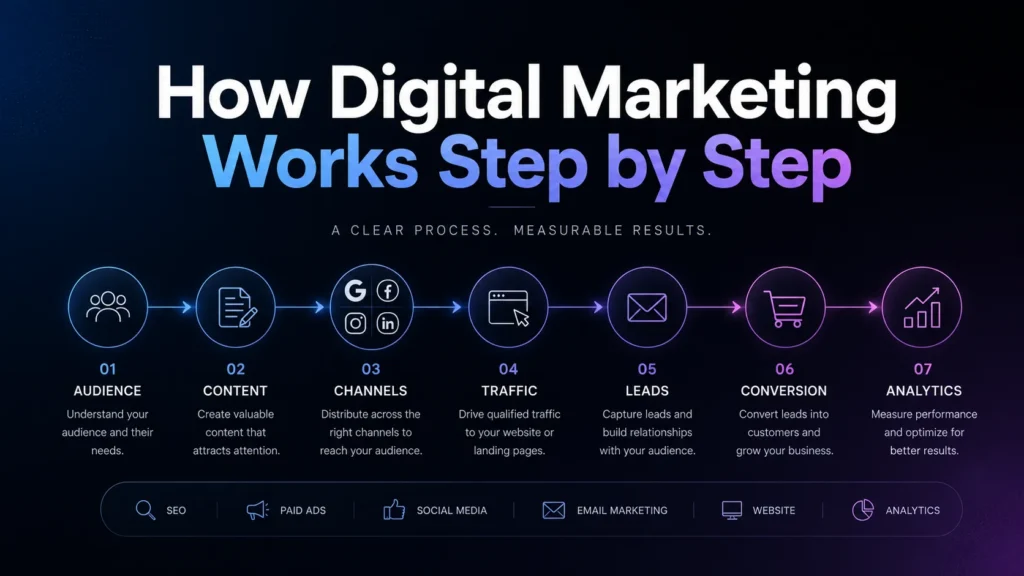
At its simplest, the process looks like this:
Business Goal → Audience → Customer Intent → Message → Content → Marketing Channel → Traffic → Lead → Conversion → Retention → Measurement → Improvement
That may look like a lot when you are completely new to marketing.
By the end of this guide, it will make sense.
Quick Answer: How Does Digital Marketing Work Step by Step?
Digital marketing works by connecting a business with potential customers through digital channels such as search engines, websites, social media, email, video platforms, online advertising, and messaging apps.
The basic process is:
- Define what the business wants to achieve.
- Understand the target customer.
- Understand what the customer wants or is searching for.
- Build the right digital presence.
- Create useful content and marketing messages.
- Choose the channels where the audience can be reached.
- Attract relevant visitors.
- Turn visitors into leads or customers.
- Measure what happened.
- Improve the process and repeat it.
The important point is that digital marketing is not a one-time activity.
It is a continuous system.
What Is Digital Marketing in Simple Words?
Digital marketing is the process of using digital channels to attract, communicate with, convert, and retain customers.
Those channels can include:
- Google Search
- Websites
- Blogs
- YouTube
- Mobile apps
- Google Ads
- Social media advertising
- Online marketplaces
- Other digital platforms
Imagine that you own a bakery.
If someone walks past your shop and sees your signboard, that is traditional offline visibility.
If the same person searches “best birthday cake near me” on Google and discovers your bakery, that is digital discovery.
If they visit your website, look at cake designs, click your WhatsApp button, ask for the price, and place an order, digital marketing helped move that person from a search to a customer.
That is the basic idea.
Digital marketing is about creating that journey intentionally.
Digital Marketing Is More Than Social Media
A common beginner mistake is to think:
Digital marketing means posting on Instagram.
Instagram can certainly be part of digital marketing.
But it is only one channel.
A business might use:
SEO to appear when people search on Google.
YouTube to educate potential customers.
Instagram to build awareness.
Google Ads to reach people actively searching for a solution.
Email to stay connected with interested customers.
A website to explain products and services.
Landing pages to collect enquiries.
Analytics to understand what is working.
All of these activities can work together.
That is why it is better to think of digital marketing as a system, not a single platform.
How Does Digital Marketing Actually Work?
There are really two journeys happening at the same time.
The Business Journey
A business may be thinking:
I need more customers.
So it begins with:
Business Goal
↓
Target Audience
↓
Marketing Strategy
↓
Content
↓
Distribution
↓
Traffic
↓
Lead
↓
Customer
The Customer Journey
The customer is thinking very differently.
Their journey may look like:
Problem
↓
Search or Discovery
↓
Interest
↓
Research
↓
Comparison
↓
Trust
↓
Action
↓
Experience
↓
Loyalty
Successful digital marketing connects these two journeys.
The business wants a customer.
The customer wants a solution.
Marketing is what connects the two.
That is one of the most important ideas to understand about digital marketing.
How Does Digital Marketing Work Step by Step?
Now let’s break down the complete process.
Step 1: Define the Business Goal
Digital marketing should not begin with Instagram.
It should not begin with SEO.
It should not even begin with advertising.
It should begin with one question:
What are we actually trying to achieve?
Different businesses need different results.
A new company may want:
- Brand awareness
- Website visitors
- App installations
- Newsletter subscribers
A service company may want:
- Phone calls
- WhatsApp enquiries
- Form submissions
- Consultation bookings
- Qualified leads
An online store may want:
- Product purchases
- Higher average order value
- Repeat purchases
A university may want:
- Enquiries
- Registrations
- Applications
- Campus visits
A restaurant may want:
- Table bookings
- Food orders
- Direction requests
- Phone calls
This matters because the goal affects almost everything that comes after it.
For example, imagine two businesses.
Business A
A new clothing brand wants more people to know it exists.
Its immediate objective might be awareness.
Business B
A plumbing company already has good visibility but needs more service enquiries.
Its objective might be lead generation.
Both businesses need digital marketing.
But they should not necessarily use the same strategy.
Do not confuse metrics with business goals
Getting 10,000 Instagram followers may feel successful.
But suppose those followers generate zero customers.
Was the marketing successful?
Maybe not.
Followers, likes, impressions, views, and clicks can be useful indicators.
But the important question is:
Did the marketing help achieve the actual business objective?
Start there.
Step 2: Understand the Target Customer
Once the goal is clear, you need to understand who you are trying to reach.
Trying to market to “everyone” usually leads to vague marketing.
Instead, ask:
- Who is most likely to need this?
- What problem are they trying to solve?
- What do they care about?
- What do they already know?
- What questions do they have?
- What might stop them from buying?
- Where do they spend time online?
- What language do they use?
- How do they normally discover products like this?
- What would make them trust a business?
Consider a simple example.
Suppose you sell affordable skincare products.
“Women” is an extremely broad audience.
A more useful audience might be:
College students and young working women looking for affordable skincare products for oily or acne-prone skin.
Now your marketing becomes easier.
Instead of creating generic content such as:
“Buy our amazing skincare products.”
you could create:
“How to Choose a Sunscreen for Oily Skin”
or:
“5 Things to Check Before Buying Sunscreen for Acne-Prone Skin”
The second approach begins with what the customer cares about.
That is good marketing.
Step 3: Understand Customer Intent
Knowing who your customer is is only part of the work.
You also need to understand what they are trying to do right now.
This is called intent.
Consider these Google searches:
Search 1
What is sunscreen?
This person is looking for information.
Search 2
Best sunscreen for oily skin
This person is researching options.
Search 3
Brand X sunscreen review
This person may already be considering a specific product.
Search 4
Buy Brand X sunscreen online
This person appears much closer to purchasing.
All four users may be interested in sunscreen.
But their intentions are different.
That means the content shown to them should also be different.
A Simple Customer Journey
Most customer journeys can be simplified into three major stages.
Awareness
The person realizes they have a problem or discovers something interesting.
Example:
“Why does my sunscreen make my skin oily?”
Consideration
The person begins researching possible solutions.
Example:
“Best sunscreen for oily skin”
Decision
The person compares options and considers taking action.
Example:
“Brand A vs Brand B sunscreen”
Digital marketing becomes more effective when the content matches the customer’s current stage.
Trying to sell immediately to someone who is only beginning to understand their problem often does not work.
Sometimes education has to come first.
Step 4: Build Your Digital Presence
Once you understand the customer, you need somewhere for that customer to discover and interact with your business.
This is your digital presence.
It may include:
- Website
- Blog
- Google Business Profile
- YouTube channel
- Instagram account
- LinkedIn profile
- Facebook page
- Email list
- WhatsApp Business
- Mobile app
- Marketplace listings
But all digital platforms are not equal.
There is an important difference between owned channels and platforms you depend on.
Owned Digital Assets
Examples include:
- Your website
- Your blog
- Your customer database
- Your email list
You have greater control over these assets.
Third-Party Platforms
Examples include:
- YouTube
- TikTok
- Marketplaces
These platforms can be extremely valuable, but you operate within their systems.
Algorithms can change.
Policies can change.
Organic reach can change.
Accounts can be restricted.
That does not mean businesses should avoid social media.
It means businesses should avoid building their entire marketing system on a platform they do not fully control.
A strong digital presence usually combines both.
Step 5: Create the Right Message and Content
Now you know:
- What you want
- Who the customer is
- What the customer wants
- Where the customer can find you
The next question is:
What should you communicate?
Good digital marketing is not about creating more content.
It is about creating the right content for the right person at the right time.
Content may include:
- Blog articles
- Videos
- Reels
- Social posts
- Guides
- Product pages
- Landing pages
- Emails
- Case studies
- Tutorials
- Comparisons
- Reviews
- Infographics
- Webinars
- Advertisements
A useful way to think about content is:
Right Person + Right Problem + Right Message + Right Format
Suppose you sell accounting software to small businesses.
A business owner who does not understand GST reporting might benefit from:
“A Beginner’s Guide to GST Reports for Small Businesses”
Someone already comparing accounting tools might need:
“What to Look for When Choosing Accounting Software”
Someone considering your product might need:
“See How Our Accounting Software Automates Monthly GST Reports”
Same business.
Different customer stages.
Different content.
Step 6: Choose the Right Digital Marketing Channels
Creating great content is only half the job.
People need to discover it.
This is where digital marketing channels come in.
Here are some of the major channels.
| Channel | How It Usually Works | Example |
|---|---|---|
| SEO | People discover your content through organic search | Google article result |
| Search Ads | You pay to appear for relevant searches | Google Ads |
| Social Media | People discover content through feeds and recommendations | Instagram Reel |
| Content Marketing | Useful content attracts and educates potential customers | Blog guide |
| YouTube | People find videos through search and recommendations | Tutorial |
| Email Marketing | You communicate with people who joined your list | Newsletter |
| Display Advertising | Visual ads appear across websites or apps | Banner ad |
| Influencer Marketing | Creators introduce a business to their audience | Product recommendation |
| Referral Marketing | Another person or website sends visitors to you | Recommendation |
| Direct Traffic | Someone already knows your brand and visits directly | Typing your website address |
The right channel depends on customer behavior.
For example:
Someone looking for an emergency plumber is likely to search Google.
Someone discovering a new fashion trend may find it first on Instagram.
Someone learning programming may spend considerable time on YouTube.
Someone evaluating enterprise software may read industry articles, LinkedIn posts, white papers, and case studies.
You do not need to be everywhere.
You need to be where your customers are.
Step 7: Attract the Right Traffic
Traffic simply means people arriving at your digital property, usually your website, landing page, store, profile, or app.
But one of the biggest marketing mistakes is assuming:
More traffic automatically means better marketing.
It doesn’t.
Imagine two websites.
Website A
100,000 visitors
50 enquiries
Website B
5,000 visitors
250 enquiries
Which website would you rather have?
Probably Website B.
The goal is not just traffic.
The goal is relevant traffic.
You want people who have a genuine reason to care about what you offer.
Where Can Digital Marketing Traffic Come From?
Organic Search
A person finds you naturally through a search engine.
Example:
They search:
“How to choose a CRM for a small business”
and click your article.
Paid Search
A person searches for something and clicks your advertisement.
Google Ads is Google’s online advertising platform, and Search campaigns can help businesses reach users actively looking for relevant products or services.
Social Media
Someone discovers your content on:
- X
- Other social platforms
Referral Traffic
Another website links to you.
A visitor clicks that link and reaches your website.
Someone clicks a link from one of your email campaigns.
Direct Traffic
Someone already knows your business and visits directly.
All of these traffic sources can play different roles in your overall marketing system.
Step 8: Turn Attention Into Leads and Customers
Getting someone’s attention is only the beginning.
Consider this progression:
Impression
Someone sees your result, post, advertisement, or content.
↓
Click
Something attracts enough interest for them to click.
↓
Visitor
They reach your website or another digital property.
↓
Lead
They indicate interest.
For example:
- Filling out a form
- Requesting a quote
- Calling
- Sending a WhatsApp message
- Booking a consultation
- Registering
- Joining an email list
↓
Customer
They complete the action that creates business value, such as making a purchase.
This progression is important because many beginners focus entirely on the first stage.
For example:
“My Reel got 100,000 views!”
Great.
But what happened next?
Did people:
- Visit the website?
- Follow the account?
- Join the email list?
- Enquire?
- Purchase?
- Remember the brand?
Marketing becomes more meaningful when you understand what happens after attention.
Step 9: Create a Good Conversion Experience
A visitor has clicked.
Now what?
This is where your website, landing page, product page, enquiry process, or checkout becomes important.
The visitor may be asking:
- Am I in the right place?
- Does this solve my problem?
- Can I trust this company?
- How much does it cost?
- What happens if I buy?
- What should I do next?
Your page should answer those questions.
What Is a Conversion in Digital Marketing?
A conversion happens when someone completes an action that matters to your business.
Depending on the business, a conversion might be:
- Buying a product
- Completing a registration
- Booking a meeting
- Submitting an enquiry
- Calling
- Downloading an app
- Starting a trial
- Requesting a quotation
- Applying for admission
In Google Analytics, important user interactions can be measured as events, while key events identify actions that are especially important to the success of the business. Google Ads conversions can then be used for campaign measurement and optimization.
What Is a CTA?
CTA means Call to Action.
It tells the user what to do next.
Examples include:
- Buy Now
- Apply Now
- Register
- Get a Quote
- Book a Demo
- Contact Us
- Call Now
- Download the Guide
- Subscribe
- Start Free Trial
A page without a clear next step can attract visitors without generating meaningful results.
Step 10: Measure What Happens
One of the most powerful characteristics of digital marketing is that many user interactions can be measured.
You can learn things such as:
- How many people discovered your content
- Which pages they visited
- How visitors reached the website
- Which campaigns generated enquiries
- Which content attracted clicks
- How many visitors completed important actions
- Which channels contributed to sales
- Where users dropped out
Google Analytics, for example, is designed to help businesses understand customer activity across websites and apps and use those insights to improve marketing performance.
You do not need to understand hundreds of metrics when you are starting.
Begin with the basics.
Important Digital Marketing Metrics for Beginners
| Metric | Simple Meaning |
|---|---|
| Impressions | How many times something was shown |
| Reach | How many individual people may have seen it |
| Clicks | How many times people clicked |
| CTR | Percentage of impressions that resulted in clicks |
| Users/Visitors | People reaching your website or app |
| Leads | Potential customers who showed interest |
| Conversion Rate | Percentage of users who completed the desired action |
| Cost per Lead | Average advertising cost required to generate one lead |
| Customer Acquisition Cost | Approximate cost of acquiring a customer |
| ROAS | Revenue generated compared with advertising spend |
| ROI | Return generated compared with overall investment |
What Is CTR?
CTR stands for click-through rate.
It measures the percentage of impressions that generate clicks.
The basic formula is:
CTR = Clicks ÷ Impressions × 100
For example:
If something is shown 1,000 times and receives 50 clicks:
50 ÷ 1,000 × 100 = 5% CTR
Google Ads uses the same clicks-divided-by-impressions relationship when defining CTR.
But remember:
A high CTR does not automatically mean a campaign is profitable.
Someone still needs to take a meaningful next action.
Step 11: Learn and Optimize
This is the step that turns digital marketing into a system.
You publish something.
You measure what happens.
You learn.
Then you improve it.
For example:
Your advertisement may receive many impressions but few clicks.
Possible issue:
The message is not interesting enough.
Another campaign may generate many clicks but no enquiries.
Possible issues:
- Wrong audience
- Misleading advertisement
- Weak landing page
- Poor offer
- Slow website
- Confusing form
- Missing trust signals
Another campaign may generate many leads but few sales.
Possible issues:
- Low-quality leads
- Pricing mismatch
- Poor follow-up
- Wrong audience expectations
- Weak sales process
Marketing is not simply:
Publish → Finished.
It is:
Plan → Launch → Measure → Learn → Improve → Repeat
That loop never truly ends.
A Real Example of How Digital Marketing Works
Let’s connect everything with one example.
Imagine a fictional skincare company called Nira Skin.
It sells an affordable sunscreen designed for oily skin.
The company wants more online sales.
1. The Business Defines Its Goal
Goal:
Generate 300 sunscreen orders per month through the website.
Now the marketing has a measurable direction.
2. The Business Defines Its Audience
Primary audience:
College students and young working women who struggle with oily skin and want affordable everyday sunscreen.
3. The Business Researches Customer Questions
Potential customers may search questions such as:
- Why does sunscreen make my skin oily?
- Is sunscreen necessary every day?
- Best sunscreen for oily skin
- Sunscreen for acne-prone skin
- SPF 30 vs SPF 50
- How much sunscreen should I use?
Those questions become content opportunities.
4. The Brand Creates Educational Content
Nira Skin publishes:
“How to Choose Sunscreen for Oily Skin: A Beginner’s Guide”
The article explains:
- What SPF means
- Texture differences
- What oily skin users should consider
- Common sunscreen mistakes
It does not begin with:
BUY OUR PRODUCT NOW!!!
It begins by solving the reader’s problem.
5. SEO Helps People Discover the Article
Someone searches:
“best sunscreen for oily skin”
They discover the article through Google.
They read it.
Now the brand has its first interaction with that potential customer.
6. The Reader Discovers the Product
Within the article, the brand naturally introduces its sunscreen as one possible solution.
The reader visits the product page.
They look at:
- Price
- Ingredients
- Reviews
- Product images
- Delivery information
But they do not purchase.
This happens often.
It does not necessarily mean the marketing failed.
The customer may simply need more time.
7. Social Media Reinforces Awareness
A few days later, the same person sees one of the brand’s Instagram videos:
“3 Sunscreen Mistakes That Can Make Oily Skin Feel Worse”
Now they recognize the brand.
That recognition matters.
The business is becoming familiar.
8. The Customer Returns
The customer searches the brand name.
They return to the website.
This time they read reviews and compare the product with alternatives.
9. The Customer Purchases
They finally click:
Buy Now
and complete the checkout.
That purchase is a conversion.
10. Marketing Continues After the Sale
The process should not necessarily end there.
The business could send:
- Order confirmation
- Product usage guidance
- Reorder reminder
- Helpful skincare content
- New product updates
If the customer likes the product, they may purchase again.
They may also recommend it to someone else.
Now digital marketing has moved beyond acquisition into retention and advocacy.
What Happened in That Example?
Let’s break it down.
SEO created discovery.
Content provided education.
The website created consideration.
Social media reinforced awareness.
Reviews helped build confidence.
The product page supported conversion.
Email could support retention.
Analytics can measure the journey.
Notice something important:
No single channel did everything.
The system worked together.
That is how modern digital marketing often works.
How Different Digital Marketing Channels Work Together
Beginners sometimes ask questions such as:
Should I use SEO or social media?
Is Google Ads better than content marketing?
Should I focus on Instagram or email?
These questions are understandable, but sometimes the better question is:
What role should each channel play in the customer journey?
Different channels are often good at different things.
SEO
Helps people discover you while actively searching.
Content Marketing
Educates, answers questions, and builds understanding.
Social Media
Helps generate discovery, attention, community, and repeated exposure.
Paid Advertising
Can place your offer in front of selected audiences or people showing relevant intent.
Email Marketing
Helps maintain communication with people who have already given you permission to contact them.
Website
Acts as a central place for information, credibility, enquiries, and conversion.
Analytics
Helps you understand how people interacted with your marketing.
One channel does not have to replace another.
They can support one another.
Digital Marketing Is a System, Not a Collection of Random Activities
This idea is worth remembering.
A business may do all of the following:
- Create Instagram posts
- Write blogs
- Run advertisements
- Send emails
- Publish YouTube videos
and still struggle.
Why?
Because activity does not automatically create strategy.
A proper system connects:
Audience
↓
Problem
↓
Offer
↓
Message
↓
Content
↓
Distribution
↓
Traffic
↓
Conversion
↓
Retention
↓
Measurement
If one part is weak, another part may not be able to compensate.
For example:
You can send 10,000 people to a terrible landing page.
More traffic may simply create more people leaving the page.
You can create a beautiful website for a product nobody wants.
Better design cannot solve the absence of demand.
You can create an excellent product but show it to the wrong audience.
The product is not necessarily the problem.
This is why digital marketing requires thinking beyond channels.
Organic vs Paid Digital Marketing
Digital marketing can broadly include both organic and paid methods.
What Is Organic Digital Marketing?
Organic marketing generally refers to visibility you are not paying a platform directly for each click or impression.
Examples include:
- SEO
- Blog content
- Organic Instagram posts
- Organic YouTube videos
- LinkedIn content
- Email sent to an existing subscriber list
- Word-of-mouth referrals
Organic growth often requires time, consistency, and strong content.
What Is Paid Digital Marketing?
Paid marketing involves spending money to distribute advertisements or sponsored content.
Examples include:
- Google Ads
- Meta Ads
- YouTube Ads
- LinkedIn Ads
- Display advertising
- Sponsored creator campaigns
Paid campaigns can generate visibility quickly, but the economics still need to make sense.
For example:
If you spend ₹20,000 on advertising and generate ₹5,000 in profit, getting more clicks does not automatically make the campaign successful.
You have to understand the business outcome.
Is Organic Marketing Better Than Paid Marketing?
Not automatically.
Both have advantages.
Organic marketing can help build long-term visibility, authority, community, and brand assets.
Paid marketing can help businesses reach relevant audiences faster, test messages, promote offers, and scale campaigns that are working.
Many businesses benefit from combining both.
A useful way to think about them is:
Organic builds assets.
Paid buys distribution.
The right balance depends on:
- Budget
- Product
- Industry
- Competition
- Customer journey
- Business goals
- Time available
The Digital Marketing Funnel Explained Simply
A marketing funnel is a simple way to understand how people move from not knowing a business to becoming customers.
One common version looks like:
Awareness
The person discovers you.
Examples:
- Reel
- YouTube video
- Advertisement
- Recommendation
↓
Interest
The person wants to know more.
Examples:
- Reads an article
- Watches a video
- Visits your profile
- Visits your website
↓
Consideration
The person begins comparing options.
Examples:
- Reviews
- Testimonials
- Product comparisons
- Case studies
- Pricing
↓
Conversion
The person takes the desired action.
Examples:
- Purchase
- Enquiry
- Registration
- Booking
↓
Retention
The customer stays connected.
Examples:
- Reorders
- Renews
- Upgrades
- Continues using the service
↓
Advocacy
The customer recommends you.
Examples:
- Review
- Referral
- Social recommendation
- Word of mouth
The customer journey is rarely perfectly linear.
Someone may visit five times.
Compare three competitors.
Leave.
Return.
Watch a video.
Ask a friend.
Then purchase.
The funnel is a useful model, not a perfect description of every person’s behavior.
A Simple Digital Marketing Framework for Beginners
If the entire article feels like a lot to remember, use this five-part framework.
The 5M Digital Marketing Framework
1. Market
Who are you trying to reach?
Understand:
- Customer
- Problem
- Need
- Intent
- Competition
2. Message
What should you say?
Your message should explain:
- What problem you solve
- Why it matters
- How you help
- Why someone should believe you
3. Media
Where will you reach them?
Examples:
- YouTube
- Paid advertising
4. Mechanism
How will someone become a customer?
Examples:
- Landing page
- Form
- Phone call
- Checkout
- Booking system
5. Measurement
How will you know whether it worked?
Measure:
- Traffic
- Leads
- Sales
- Conversion rate
- Customer acquisition
- Revenue
- Profitability
Whenever you are confused about a digital marketing strategy, return to these five questions.
What Digital Marketing Is NOT
Understanding digital marketing becomes easier when you also understand what it is not.
Digital marketing is not just posting on Instagram
Social media is one part of digital marketing.
Digital marketing is not just running advertisements
Advertisements can generate reach or traffic.
They cannot automatically fix:
- A weak product
- Poor positioning
- A confusing website
- Bad pricing
- A poor customer experience
Digital marketing is not getting followers
Followers can be valuable.
But follower count alone does not tell you whether a business is growing.
Digital marketing is not publishing random blog posts
Content should ideally connect to:
- Customer questions
- Search intent
- Business expertise
- The customer journey
Digital marketing is not using AI to publish hundreds of pages
AI can help with research, ideation, analysis, editing, and production.
But publishing large volumes of generic content does not automatically create a useful website.
Google’s current Search guidance continues to prioritize helpful, reliable, people-first content and recommends adding unique value rather than reproducing material that already exists elsewhere.
Random Marketing vs Structured Digital Marketing
Here is another easy way to understand the difference.
Random Marketing
Create Reel
↓
Boost Post
↓
Get Likes
↓
Send Visitors Somewhere
↓
Hope Someone Buys
↓
No Proper Tracking
↓
Repeat
Structured Digital Marketing
Business Goal
↓
Audience
↓
Customer Intent
↓
Offer
↓
Message
↓
Channel
↓
Content
↓
Landing Experience
↓
Conversion
↓
Measurement
↓
Optimization
↓
Repeat
The second approach does not guarantee success.
But at least you know why each activity exists.
How Do You Know If Digital Marketing Is Working?
Do not judge every campaign by the same metric.
The right measurement depends on the goal.
If your goal is awareness, you may care about:
- Relevant reach
- Impressions
- Brand searches
- Video views
If your goal is website acquisition, you may care about:
- Relevant traffic
- Search visibility
- Click-through rate
- Engaged visitors
If your goal is lead generation, you may care about:
- Number of qualified leads
- Conversion rate
- Cost per lead
- Lead quality
If your goal is sales, you may care about:
- Purchases
- Revenue
- Customer acquisition cost
- ROAS
- Profit
- Repeat purchases
A metric becomes meaningful when it is connected to a goal.
Can Small Businesses Use Digital Marketing?
Absolutely.
In fact, a small business does not need to begin with ten different marketing channels.
A simple starting system could be:
1. Build a good website or landing page
2. Create or optimize a Google Business Profile if the business serves a local area
3. Understand the questions customers search
4. Create useful content
5. Use one or two social platforms relevant to the audience
6. Track calls, enquiries, forms, or sales
7. Improve based on results
Start small.
Learn.
Then expand.
Being active everywhere is less important than being useful somewhere.
Can You Do Digital Marketing Without Paid Ads?
Yes.
Digital marketing does not require paid advertising.
A business can attract customers through:
- SEO
- Blog content
- YouTube
- Organic social media
- Email marketing
- Communities
- Partnerships
- Referral marketing
- Local search visibility
However, “free” does not always mean there is no cost.
Organic marketing still requires:
- Time
- Content creation
- Expertise
- Tools
- Design
- Website maintenance
- Consistency
You are simply investing resources differently.
How Long Does Digital Marketing Take to Work?
There is no single answer because different channels behave differently.
Paid advertising can begin generating traffic soon after a campaign goes live.
SEO usually requires more patience because pages need to be discovered, indexed, evaluated, and compete with other results.
Social media results can vary dramatically depending on the platform, content, audience, format, and existing community.
Email may work quickly if you already have an engaged list.
The better question is:
How long should this specific strategy reasonably take before we have enough data to evaluate it?
Different channels need different expectations.
Is SEO Part of Digital Marketing?
Yes.
Search engine optimization, or SEO, is one part of digital marketing.
SEO focuses on improving a website’s ability to be discovered through organic search results.
Digital marketing is broader.
It can include:
- SEO
- Paid search
- Social media
- Content
- Video
- Influencer marketing
- Analytics
- Conversion optimization
- Other digital channels
Think of digital marketing as the larger system and SEO as one important part of that system.
What Is the Difference Between Digital Marketing and Social Media Marketing?
Digital marketing includes marketing through many types of digital channels.
Social media marketing focuses specifically on social platforms.
For example:
SEO = digital marketing
Google Ads = digital marketing
Email marketing = digital marketing
Instagram marketing = digital marketing + social media marketing
So all social media marketing is digital marketing, but not all digital marketing is social media marketing.
What Should Come First in Digital Marketing?
The first step should usually be understanding:
1. The business objective
and
2. The customer
Not:
“Which platform should we post on?”
The channel comes later.
If you do not understand the customer, it is difficult to know:
- What message to create
- What content to publish
- Which platform to choose
- What offer to make
- What action to optimize for
Strategy begins before distribution.
Common Digital Marketing Mistakes Beginners Make
1. Trying Every Platform at Once
More channels create more work.
Start where your audience and opportunity are strongest.
2. Focusing Only on Followers
Followers are not the same as customers.
3. Creating Content Without Understanding Search Intent
A person searching for information should not always receive a hard sales pitch.
4. Sending Everyone to the Homepage
Sometimes a dedicated landing page is much more relevant.
5. Not Tracking Conversions
If you only measure page views and likes, you may never know which marketing activity actually contributes to results.
6. Changing Strategy Too Quickly
Some marketing channels need time to produce useful data.
7. Copying Competitors
Competitor research is useful.
Competitor imitation is not a strategy.
Understand what others are doing, then determine how you can be more useful, specific, credible, or differentiated.
8. Confusing Activity With Progress
Publishing every day does not automatically mean marketing is improving.
Ask:
What did we learn?
A Beginner’s Digital Marketing Checklist
Before launching any digital marketing activity, answer these questions:
- What exactly is the business goal?
- Who is the customer?
- What problem are they trying to solve?
- What do they already know?
- What might stop them from taking action?
- Where do they spend time online?
- What are they searching for?
- What message would be useful to them?
- What content format makes sense?
- Which channel should distribute that content?
- Where will interested users go?
- What action should they take?
- How will that action be measured?
- What does success look like?
- What will you improve based on the results?
If you cannot answer several of these questions, you may not have a complete marketing strategy yet.
Frequently Asked Questions About How Digital Marketing Works
How does digital marketing work in simple words?
Digital marketing works by helping a business reach potential customers through online channels, provide useful information or offers, encourage people to take an action, measure the results, and improve future marketing based on what happened.
What are the main steps in digital marketing?
The basic digital marketing process is:
- Set a business goal.
- Identify the target customer.
- Understand customer intent.
- Build the right digital presence.
- Create a useful message and content.
- Choose marketing channels.
- Generate relevant traffic.
- Convert visitors into leads or customers.
- Measure performance.
- Optimize and repeat.
What are the main types of digital marketing?
Common types include:
- SEO
- Content marketing
- Search advertising
- Social media marketing
- Email marketing
- Video marketing
- Influencer marketing
- Affiliate marketing
- Display advertising
- Mobile marketing
These are different channels and tactics that can be combined into one broader strategy.
What is a lead in digital marketing?
A lead is a potential customer who has shown meaningful interest in a business.
Examples include someone who:
- Submits an enquiry form
- Calls the business
- Requests a quotation
- Books a consultation
- Registers for a demo
Not every website visitor is a lead.
What is a conversion in digital marketing?
A conversion is an important action completed by a user.
Depending on the business, that could be a purchase, form submission, registration, phone call, booking, app installation, or another valuable action.
What is a digital marketing funnel?
A digital marketing funnel is a simplified model showing how people move from first discovering a business to becoming customers.
It commonly includes:
Awareness → Interest → Consideration → Conversion → Retention
Does digital marketing require money?
Not always.
Businesses can use organic methods such as SEO, content marketing, YouTube, organic social media, referrals, and email.
However, these still require time, skill, technology, or other resources.
Paid advertising requires a direct advertising budget.
Can beginners learn digital marketing?
Yes.
The easiest way is to first understand the overall customer journey before trying to master individual platforms.
Start with:
Customer → Problem → Content → Channel → Website → Conversion → Measurement
Once that makes sense, SEO, social media, advertising, analytics, and other topics become easier to understand.
Is digital marketing difficult?
The basic concepts are not especially difficult.
The challenge comes from applying them effectively.
Real businesses have:
- Different customers
- Different budgets
- Different products
- Different competition
- Different sales cycles
There is rarely one strategy that works perfectly for everyone.
How do businesses measure digital marketing success?
Businesses measure success based on the objective.
Possible measurements include:
- Traffic
- Leads
- Sales
- Revenue
- Conversion rate
- Customer acquisition cost
- Advertising return
- Repeat purchases
The most useful metric is the one connected to the business goal.
Final Thoughts: How Digital Marketing Really Works
Digital marketing can seem complicated because people often learn it in pieces.
One tutorial teaches SEO.
Another teaches Instagram.
Another teaches Google Ads.
Another explains email marketing.
Another talks about analytics.
When you study them separately, digital marketing can look like a collection of unrelated tools.
It becomes much easier when you see the complete system.
A business has a goal.
It identifies the right customer.
The customer has a problem, need, or desire.
The business creates a useful message.
That message becomes content.
Content is distributed through the right channels.
People discover it.
Some become visitors.
Some visitors become leads.
Some leads become customers.
Some customers return.
The business measures what happened.
Then the process improves.
In one line:
Goal → Customer → Intent → Message → Content → Channel → Traffic → Conversion → Retention → Measurement → Improvement
That is how digital marketing works.
The platforms will change.
Algorithms will change.
New tools will appear.
AI will change how people search, discover, compare, and create.
But the fundamental purpose of marketing remains much more stable:
Understand people, create genuine value, communicate it clearly, make it easy to take the next step, and learn from the result.
If you understand that system first, learning SEO, Google Ads, social media marketing, content marketing, email marketing, analytics, automation, and other digital marketing disciplines becomes far easier.